
Industries & Impact
Broken or Cracked Cast Part — Replacement from a Sample
Broken pump housing, cracked valve body, fractured gearbox or bearing housing, split volute — and the OEM is gone. The broken sample is the datum. We 3D-scan it, reconstruct the fracture face and the as-new envelope in CAD, identify the parent alloy in-house by spectrometry, and pour an ASTM-spec replacement in a patternless 3D-printed sand mold. No pattern, no minimum order. One piece is a real quote; a typical broken-cracked reverse-engineered campaign runs 1 to 20 pieces. Independent US foundry — not a repair shop, not a stockist, not the aftermarket arm of a pump, valve, gearbox, or bearing OEM.
Who this page is for
Written for MRO and reliability engineers, maintenance planners, and sourcing at industrial operators with a broken or cracked cast part on the floor and often no OEM left to call — industrial pumps and valves, gearbox and bearing housings on off-highway and process equipment, compressor cylinders and distance pieces, hydro and steam turbine ancillaries, waterworks pump and valve castings, and legacy structural castings on walked-away machinery. Rebuild shops quoting a 1 to 20 piece replacement run on a discontinued platform are in scope. Design engineers at OEMs inheriting a walked-away supplier are in scope. Hobbyists, price-shoppers with no spec, and buyers whose line has to ship tomorrow are not, and this page will make that clear before the quote conversation starts.
The short answer
A broken or cracked cast part can be reverse-engineered into an ASTM-spec cast replacement without original drawings, without OEM cooperation, and without a pattern. The workflow: scan the broken sample, reconstruct the fracture face and the as-new envelope in CAD from unworn reference features, identify the parent alloy by optical-emission spectrometry, choose the ASTM grade appropriate to the service, simulate solidification on pressure- and thickness-sensitive sections, and pour from a 3D-printed sand mold. From a released CAD, plan on multiple weeks to finished, machined, inspected castings with an EN 10204 3.1 Material Test Report; add up-front time when we are reverse-engineering from the broken sample. Quantity range that fits patternless economics: 1 to 100 pieces per job, with the broken-cracked reverse-engineered subset typically at 1 to 20 (Steel Founders' Society of America — 3D sand printing overview).
The scenario — broken cast part, no drawings, OEM gone
The pattern is familiar. A cast component fails in service: a fatigue crack through a gearbox housing at a bolt boss, a cavitated volute that finally split, a valve body with a through-wall crack from thermal cycling, a bearing housing broken at the seal register from a hard misalignment event, a compressor distance piece cracked at the shoulder. The buyer opens the OEM's website and the model is discontinued; the OEM has been acquired, wound down, or walked away from that platform. A stocking distributor for the exact part number does not exist. There are no drawings. The broken casting is on the floor and the plant needs a replacement so the equipment can run again.
This is the working case a patternless short-run foundry is designed to solve. It is not a good fit if the plant needs the part shipped tomorrow (no engineering-grade casting compresses melt, heat-treat, machine, and inspect into 24 hours), if 500-plus identical pieces per year are needed indefinitely (hard-tooled sand casting is cheaper per piece at that volume), or if the drawing calls for pressure-vessel code stamps or API monograms the foundry does not carry. Everything else — obsolete pump volutes and casings, walked-away valve bodies, broken gearbox and bearing housings, cracked compressor cylinders and distance pieces, obsolete hydro-turbine ancillaries, legacy structural castings — sits squarely in scope.
Reverse-engineering from the broken sample
The broken sample carries the geometry the original drawing carried. Recovering it is a disciplined engineering exercise, not a photograph-and-eyeball job:
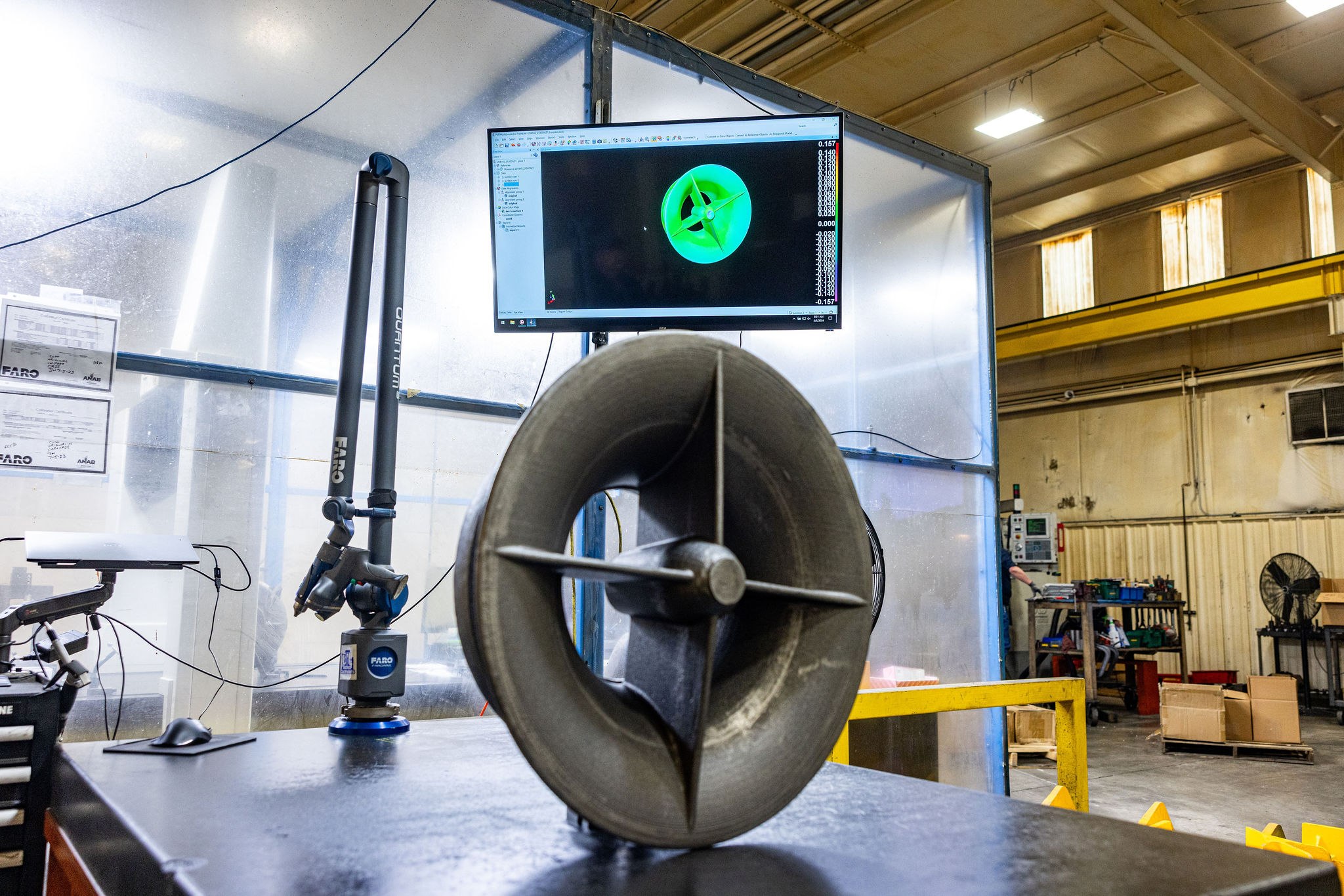
- 3D scan the broken casting. Structured-light or laser-arm scanning captures the intact external geometry as a dense point cloud. For internal geometry — hydraulic passages, cored bores, oil galleries — the practical options are CT through a bureau, destructive sectioning of a scrap sample, or dimensional measurement of the mating internal part if scanning is not practical. See our scan-file requirements page for what a foundry-usable scan looks like.
- Reconstruct the fracture face and the as-new envelope in CAD. The intact portions of the casting drive the CAD rebuild. Unworn cast draft, flange faces, bolt-pattern datums, cast letters and part numbers on the shoulder, and any surface that never saw the failure mode all carry the original as-new dimensions. Symmetry across a design centerline gives an unworn half a datum for the fractured half. Mating parts — the impeller inside the volute, the bearing on the housing register, the bonnet on the valve body — geometrically define the envelope the reconstructed CAD has to close back to.
- Identify the parent alloy. Optical-emission spectrometry on a coupon cut from the broken casting resolves the parent chemistry to an ASTM grade — ductile-iron A536, carbon-steel A216, austenitic-stainless A351, martensitic-stainless CA6NM, duplex CD4MCuN. If the chemistry falls between grades or the alloy is not on our pour list, we will say so and route.
- Run solidification and filling simulation. Pressure-containing sections, thick shell walls, and thin transitions are simulation-sensitive; the pour is validated in software before any sand is printed. See our casting simulation page.
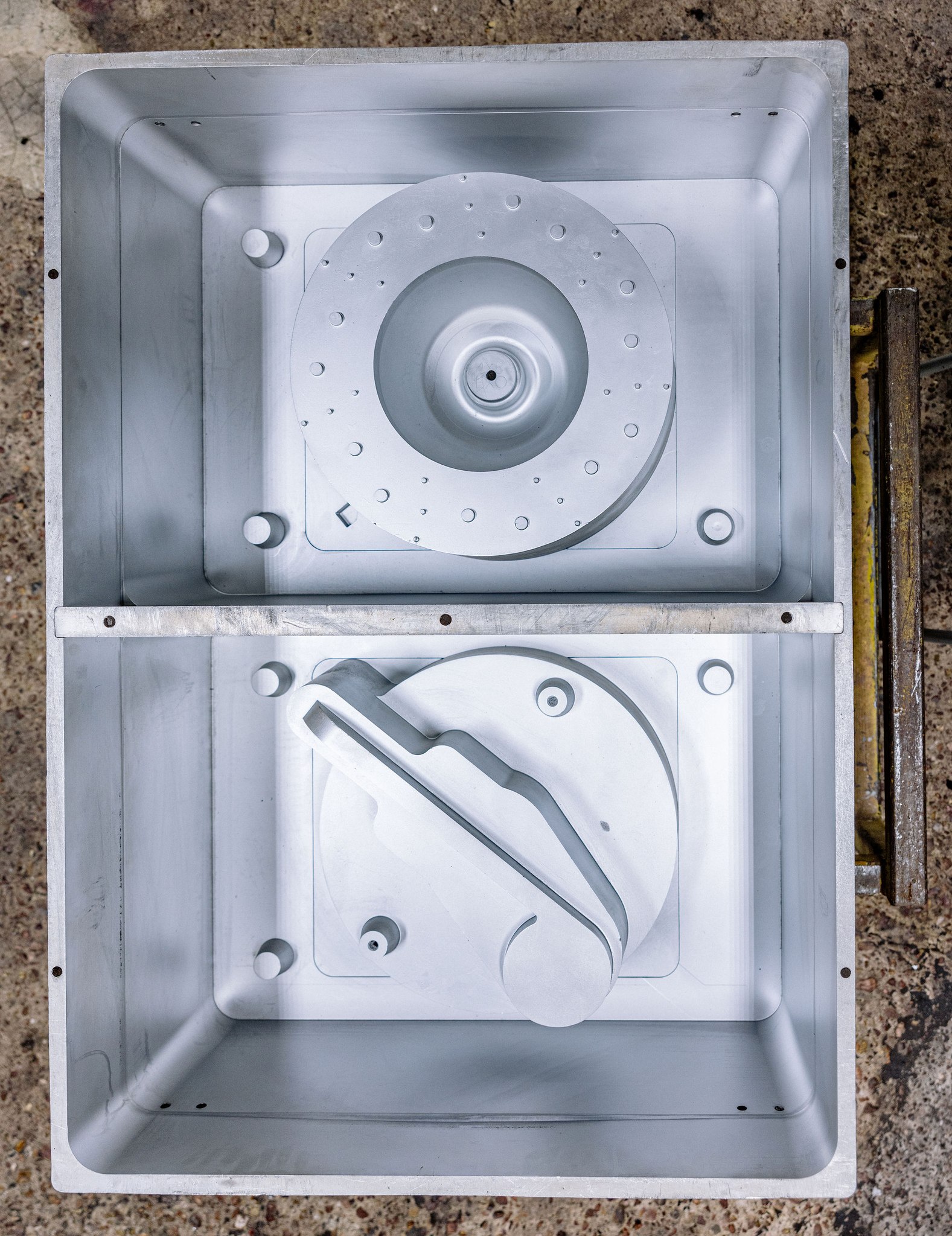
- Print the sand mold. The cope, drag, and internal cores are printed direct from the CAD as a bonded silica-sand mold — no wooden pattern, no core-box tooling, no 8–16 week hard-tool build.
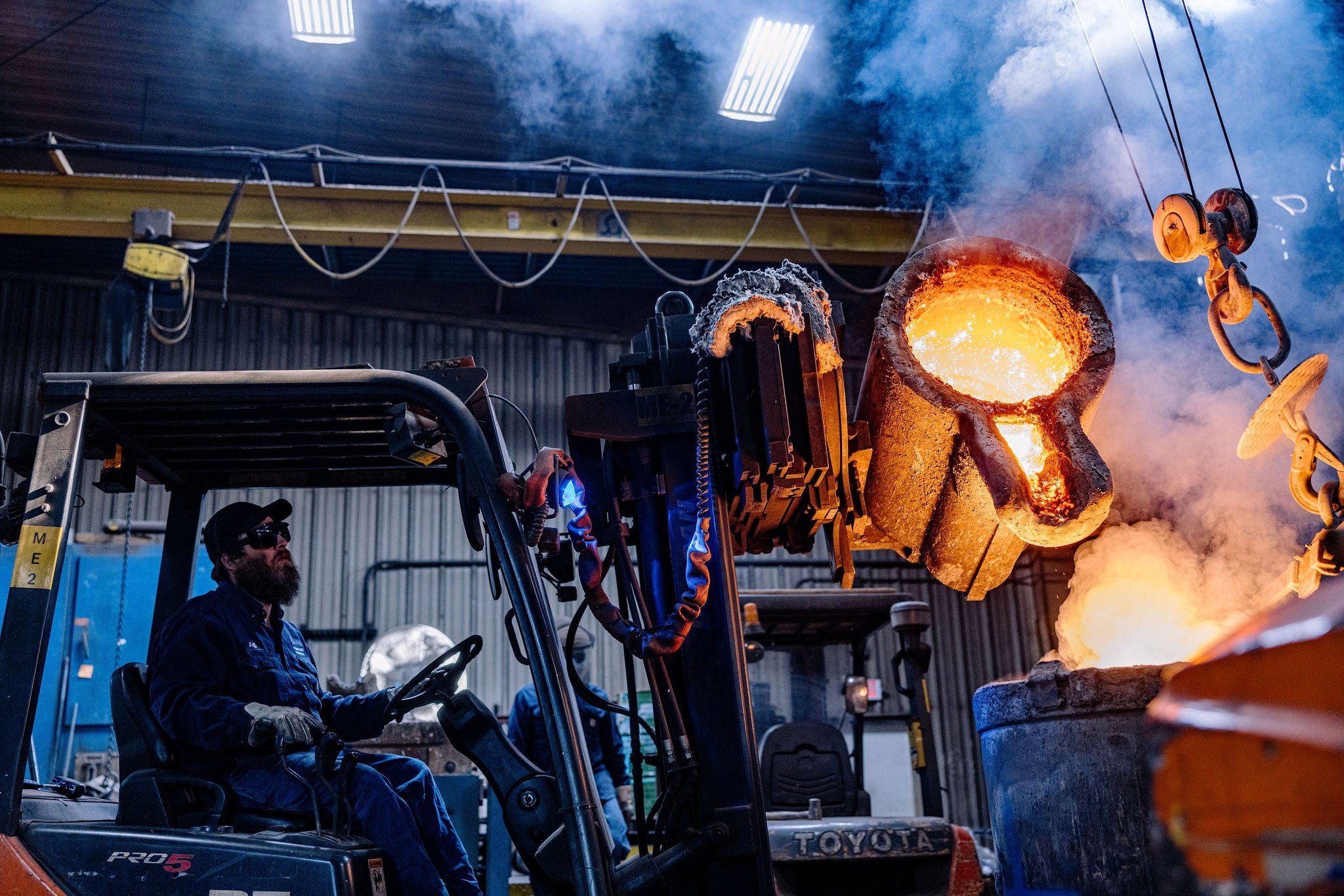
- Pour, heat treat, machine, inspect, and ship. Alloy-appropriate heat treat (normalize on ductile iron, stress-relieve on carbon steel, solution and temper on austenitic stainless, air-harden and temper on martensitic CA6NM / CA15, solution treat and rapid-quench on duplex CD4MCuN), CNC of critical machined features, NDE per the drawing's acceptance program, First Article Inspection, and a Material Test Report on the heat.
The full scan-to-mold-to-metal workflow — scanner types, CAD rebuild practice, tolerance recovery logic — lives on our reverse-engineering pillar page. Companion workflows for the two most-often-broken part types on our RFQ desk are the pump volute and casing replacement page and the pump impeller replacement page.
Alloys we pour for broken and cracked cast part replacements
The alloys we pour, framed by service on the drawing rather than by pump / valve / equipment brand — full detail on metals poured:
- ASTM A48 gray iron (Class 25 through 40)
- Light-duty legacy structural, damping, and low-pressure service castings. Not the choice where impact or pressure ratings step up.
- ASTM A536 ductile iron (60-40-18, 65-45-12, 80-55-06, 100-70-03)
- The workhorse for gearbox and bearing housings, valve bodies, pump volutes, waterworks fittings, and general-industrial structural castings. Higher-strength 100-70-03 for higher-load duty. Ductile Iron Society property reference: ductile iron mechanical properties.
- ASTM A439 D2 austenitic ductile
- Ni-alloyed austenitic ductile for corrosion-plus-moderate-wear service and for elevated-temperature thermal-cycling parts where a standard A536 is under-spec but a stainless is over-spec.
- ASTM A216 WCA, WCB, WCC carbon steel
- Cast carbon steel for higher-pressure, higher-temperature general-industrial service — valve bodies, pump casings, compressor cylinders, structural castings. Weldable and field-repairable; stress-relieved after pour and rough machining.
- ASTM A352 LCB low-temperature carbon steel
- Impact-tested low-temperature carbon steel for cold-service castings that require Charpy V-notch acceptance at reduced temperature. LCB is on our pour list; the deeper cryogenic LC2 / LC3 / LC4 grades are not.
- ASTM A351 / A743 / A744 CF8M and CF3M austenitic stainless
- Molybdenum-bearing austenitic stainless — the standard chemical-service and waterworks cast-stainless alloy. CF3M is the low-carbon variant for weldability-sensitive service. Procurement detail on our CF8M procurement page.
- ASTM A487 and A743 CA6NM martensitic stainless
- Air-hardenable martensitic stainless with cavitation resistance — hydro-turbine, dredge-pump, and mining slurry pump wet-end territory. Air-hardens to the mid-40s HRC after solution and temper.
- ASTM A487 and A743 CA15 martensitic stainless
- Lower-alloy martensitic stainless with a similar envelope to CA6NM at reduced cost where CA6NM is over-spec.
- ASTM A890 / A995 CD4MCuN duplex stainless
- Two-phase austenitic-ferritic duplex for chloride-heavy service, wet abrasion with chloride, and stress-corrosion-cracking service. A995 is the pressure-rated variant.
- ASTM B26 aluminum (319, C355, A356)
- Cast aluminum for weight-sensitive housings and structural castings with in-house heat treat.
If the drawing calls for an alloy we do not pour, we say so on the first call. The routing ring is honest and specific:
- Weld-repair of the broken casting
- We pour a new casting from the sample as a datum — we do not repair the broken original. Field structural weld repair on a re-usable casting goes to a repair specialist.
- Machining from billet
- If the geometry suits solid-bar machining better than a cast blank, that path lives at a precision machine shop.
- Ni-Hard, high-chrome white iron, ASTM A128 Hadfield manganese
- Impact-and-abrasion wear parts — crusher jaws, mill liners, mantle-and-bowl parts. Specialty wear-part foundries own these grades.
- Nickel-base severe-corrosion alloys
- Alloy 20 (CN7M), Hastelloy C-276, Inconel 625 or 725. Ni-base melt practice we do not run; Ni-base specialty foundries pour these.
- Super-duplex stainless beyond CD4MCuN
- Higher-PREN grades — A890 CE3MN, CD3MWCuN, and similar — sit at super-duplex specialists.
- ASTM A217 chrome-moly
- WC6, WC9, C5, C12, C12A high-temperature chrome-moly for main-steam and superheated service. Route to pressure-vessel cast-steel specialists.
- Cast bronze / aluminum-bronze / Ni-Al-bronze
- ASTM B584 / B148 copper-alloy pump wet ends and marine components. We pour cast aluminum, not cast bronze — non-ferrous specialty foundries pour these.
- Wrought, rolled, or forged product
- Bar, plate, pipe, and forgings are not castings and are a different supply chain. The reverse-engineered cast replacement is the deliverable we quote.
- ASME U-stamp, ASME III N-stamp, API 6A / 610 / 618 monograms
- We cast to the drawing's spec and ship the paperwork that supports the buyer's engineer's qualification path. We do not carry the code-stamp or monogram authority ourselves.
- 500-plus pieces per year of the same casting indefinitely
- Hard-tooled sand casting is cheaper per piece at that annual volume — we will name a hard-tooled foundry rather than pretend to be the fit.
- Hobby, decorative, one-piece novelty work
- Outside our engineering scope — see the low-volume high-complexity page for the project profile we run.
- Line-down parts that have to ship tomorrow
- No engineering-grade casting compresses melt, heat treat, machine, and inspect into 24 hours. Call before failure, not after.
The NDE and MTR package on every casting
The acceptance program is what turns a metal shape into a qualified engineering component. On broken-cracked reverse-engineered work, the standard package we build against:
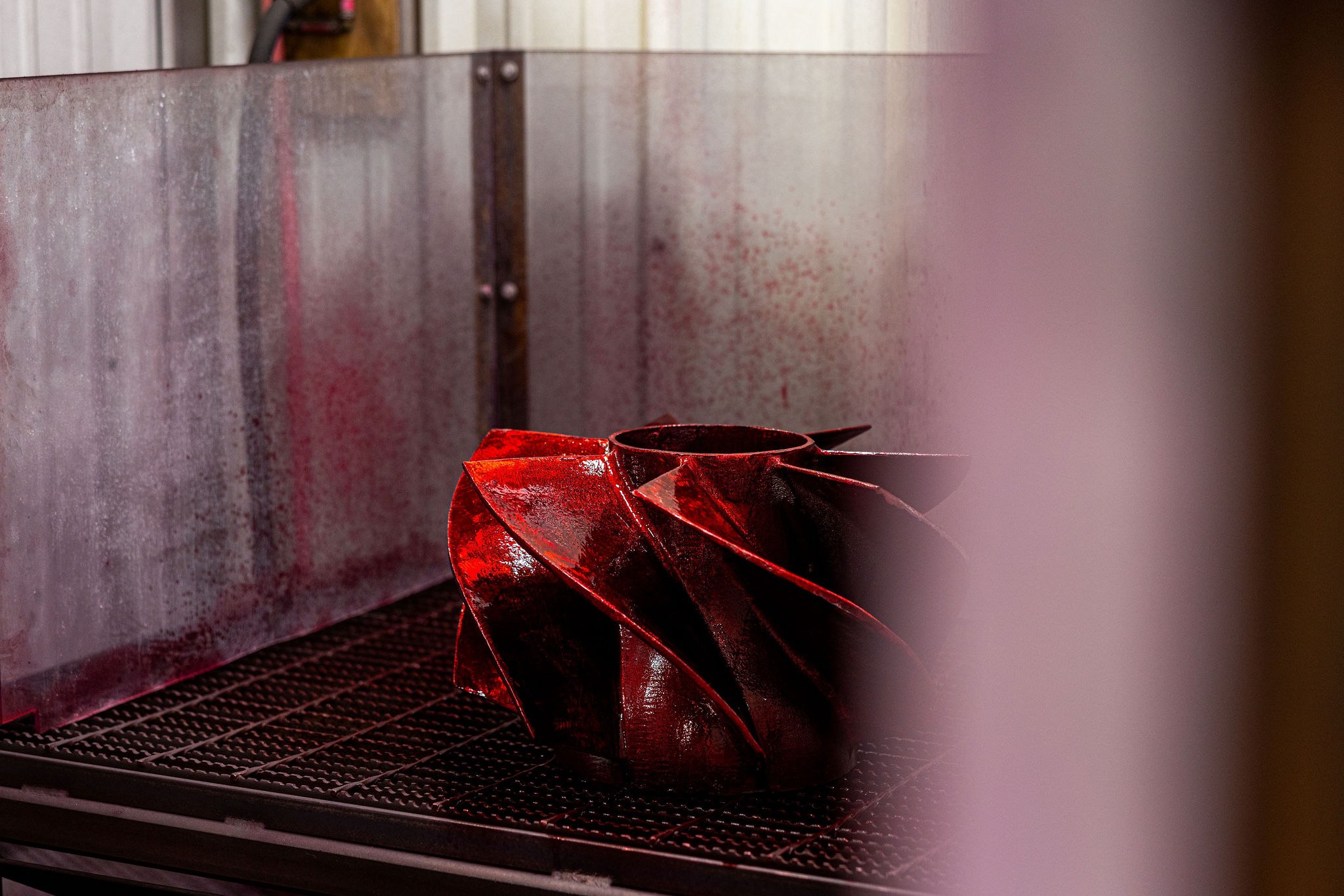
- Liquid penetrant inspection (LPI) per ASTM E165 on machined critical surfaces — the default surface-flaw inspection on austenitic-stainless (CF8M, CF3M) and duplex (CD4MCuN) castings where MPI is not applicable.
- Magnetic-particle inspection (MPI) per ASTM E709 on machined critical surfaces of ferromagnetic castings — carbon steel, ductile iron, martensitic stainless (CA6NM, CA15).
- Ultrasonic examination (UT) per ASTM A609 on heavy sections of carbon, low-alloy, and martensitic-stainless steel castings.
- Radiographic examination (RT) per ASTM E94 by exception on pressure-boundary sections when the drawing's acceptance level calls for it.
- Visual acceptance per MSS SP-55 — the visual quality standard for steel castings for valves, flanges, and fittings, which we use as the visual acceptance datum across ferrous work.
- Material Test Report (MTR) per EN 10204 Type 3.1 on the heat — chemistry by optical-emission spectrometry and mechanicals from a poured coupon, sampled per the ASTM grade the drawing names.
- Positive Material Identification (PMI) on the finished casting on request.
- First Article Inspection (FAI) against the released CAD reconstructed from the broken sample — the reliability engineer signing the release sees exactly which features were rebuilt from unworn reference geometry and which were carried through from the intact portions of the sample.
Full acceptance program on inspection & QC. On steel castings specifically, the Steel Founders' Society of America Steel Castings Handbook (Supplement 3 — NDT of steel castings) is the industry reference we build acceptance criteria against.
Not a repair shop, not an OEM aftermarket, not a stockist
The buyer with a broken cast part in front of them has three service models to choose from, and knowing which one calls back is worth an hour of RFQ time:
- A repair shop welds the crack, machines a shoulder, and returns the same casting to service. Sometimes right — often the fastest path when the fracture is on a non-critical feature and the casting has service life left in it. Not us.
- An OEM aftermarket parts arm ships a new part on the original OEM's part number, or a rebranded equivalent. When the OEM is alive and the part is in-catalog, this is the default path. When the OEM is gone or the part is obsolete, this path ends. Not us either.
- A stockist or a distributor holds the same castings the OEM used to sell, sometimes for years after the OEM winds down. When the shelf is bare, the buyer is looking for the fourth option. That is us.
An independent US foundry pours a new casting to the buyer's specification, from a reverse-engineered CAD, in a printed sand mold, without an OEM relationship and without a repair-vs-replace judgment call on the specific broken casting in front of the buyer. We are the fourth option — the one that exists when the first three do not.
What to send with your RFQ
- The broken or cracked sample if you have it — on a pallet, in a crate, or shipped freight. If it is on a hazardous or oversized envelope, tell us and we will work the logistics.
- If the sample is already scanned, the mesh file (STL, PLY, or STEP) — see our scan-file requirements.
- The ASTM alloy grade you want on the finished part — or a description of the service (pressure, temperature, medium, chloride content) and we will suggest the grade. Our ASTM grade decision page walks the A216 / A536 / A743 call.
- Quantity and timeline — typical broken-cracked campaign is 1 to 20 pieces; per-job book is 1 to 100.
- Critical machined features, tolerances, and their datum references (from a shaft-running centerline or a machined face, not from a cast surface).
- The NDE program and acceptance criteria (LPI to ASTM E165, MPI to ASTM E709, UT to ASTM A609, RT to ASTM E94, MSS SP-55 visual) and the MTR level (EN 10204 3.1 is our standard; 3.2 with third-party witness is a lead-time move).
- The end-service context — temperature, pressure, medium, and any known failure mode on the broken original. Alloy sanity-check.
Send it to /contact-1 or drop an email. Companion pages: replacing a discontinued pump or valve casting, reverse-engineered heavy-equipment wear parts, reciprocating compressor cylinder replacement, made-in-USA domestic-melt replacements, from broken part to digital blueprint, and legacy part replication.
Related reading on this site
- Lead times for a replacement casting when a line is down — the planning bands that sit on this workflow.
- Waterworks pump & valve parts, short run — municipal wet-end replacements from a sample.
- Short-run turbine & energy castings — CA6NM and carbon-steel replacements in the same patternless book.
Sources and standards referenced
- ASTM E165 / E165M — Standard Practice for Liquid Penetrant Testing.
- ASTM E709 — Standard Guide for Magnetic Particle Testing.
- ASTM E94 / E94M — Standard Guide for Radiographic Examination.
- ASTM A609 / A609M — Ultrasonic Examination of Carbon, Low-Alloy, and Martensitic Stainless Steel Castings.
- MSS SP-55 — Quality Standard for Steel Castings for Valves, Flanges, and Fittings (Visual Evaluation).
- EN 10204 — Metallic products, types of inspection documents (Type 3.1 MTR).
- ASTM A536 — Standard Specification for Ductile Iron Castings.
- ASTM A216 / A216M — Steel Castings, Carbon, Suitable for Fusion Welding, for High-Temperature Service.
- ASTM A351 / A351M — Castings, Austenitic, for Pressure-Containing Parts.
- ASTM A743 / A743M — Iron-Chromium and Iron-Chromium-Nickel Corrosion-Resistant Castings.
- ASTM A890 / A890M — Castings, Iron-Chromium-Nickel-Molybdenum Corrosion-Resistant, Duplex (Austenitic / Ferritic).
- Steel Founders' Society of America — Steel Castings Handbook, Supplement 3, NDT of Steel Castings.
FAQ
Can you cast a replacement from a broken cast part when the OEM is gone and there are no drawings?
Yes. The broken sample is the datum. We 3D-scan the intact portions of the casting, reconstruct the fracture face and the as-new envelope in CAD from unworn reference geometry (cast draft, flange faces, bolt patterns, mating parts), identify the parent alloy by optical-emission spectrometry, and pour a replacement to a named ASTM grade in a 3D-printed sand mold. No original drawings, no pattern, and no OEM cooperation are required. The workflow lives on our reverse-engineering pillar page; scan-file requirements are on our scan-file page.
What alloys do you pour for a broken or cracked cast part replacement?
Gray iron (ASTM A48), ductile iron (ASTM A536 in 60-40-18, 65-45-12, 80-55-06, 100-70-03; ASTM A439 D2 austenitic ductile), carbon and low-alloy steel (ASTM A216 WCA / WCB / WCC; ASTM A352 LCB), martensitic stainless (ASTM A487 and A743 CA6NM or CA15), austenitic stainless (ASTM A351, A743, and A744 CF8M or CF3M), duplex stainless (ASTM A890 or A995 CD4MCuN), and aluminum (ASTM B26 319, C355, A356). If your part is in an alloy we do not pour — ASTM A217 chrome-moly, Ni-Hard / high-chrome white iron, ASTM A128 Hadfield manganese, Ni-base (Alloy 20, Hastelloy, Inconel), super-duplex beyond CD4MCuN, or cast bronze / aluminum-bronze — we will say so on the first call and route the RFQ honestly to a specialty foundry. Our full pour list is on metals poured.
Do you need a pattern or hard tooling for one broken part?
No. The mold is 3D-printed direct from the CAD reconstructed from your scan — a bonded silica-sand cope, drag, and cores, printed and staged for pouring in days rather than the 8–16 weeks a hard pattern takes to build. That is what makes one piece a real quote and not a rounding error. Read 3D sand printing capability for the process detail.
What inspection reports and paperwork ship with the casting?
Standard documentation package: liquid penetrant to ASTM E165 on machined critical surfaces (or magnetic-particle to ASTM E709 on ferromagnetic alloys), ultrasonic to ASTM A609 on heavy sections of carbon, low-alloy, and martensitic-stainless steel castings, radiographic to ASTM E94 by exception on pressure-boundary sections when the drawing calls for it, visual acceptance to MSS SP-55, PMI on the finished part on request, a First Article Inspection against the released CAD, and an EN 10204 Type 3.1 Material Test Report on the heat with chemistry by optical-emission spectrometry and mechanicals from a poured coupon. Tell us the acceptance package the reliability team files against and we build the documentation to match.
Are you a repair shop or a foundry?
A foundry. We pour a new casting from the reverse-engineered CAD. We do not weld-repair the broken original, we do not machine the part from billet, and we are not tied to any pump, valve, gearbox, or bearing OEM aftermarket program. If your part is a candidate for weld-repair or machining-from-solid instead, we will say so honestly and route the RFQ.
Is there a minimum order?
No. One piece is a real quote. A typical broken-cracked reverse-engineered campaign runs 1 to 20 pieces; our full short-run book covers 1 to 100 pieces per job. Above roughly 500 pieces per year of the same casting indefinitely, a hard-tooled pattern shop is cheaper per piece and we will say so up front — see our no-minimum-order US foundry page and how much a one-off casting costs.
Can the replacement be pressure-rated, ASME code-stamped, or API 610 / API 618 monogrammed?
No. We cast to the specification you provide — alloy, tolerances, NDE package, MTR — and we can run solidification simulation on pressure-containing sections before we commit the mold. We do not hold ASME BPVC Section VIII U-stamp, ASME Section III N-stamp, or API 6A / 610 / 618 monogram authority. Your engineer owns the pressure-rating and code qualification for service; we ship the casting with the paperwork that supports that qualification.
How long does a broken-sample-to-casting replacement take?
It depends on alloy, size, geometry, and inspection package. A typical patternless short-run from a broken sample runs: scan and CAD reconstruction over a handful of days, printed-sand-mold build and pour over a few weeks, alloy-appropriate heat treat (normalize on ductile iron, stress-relieve on carbon steel, solution and temper on austenitic stainless, air-harden and temper on CA6NM martensitic, solution treat and rapid-quench on CD4MCuN duplex), rough and finish CNC of critical machined features, NDE, First Article, and MTR before ship. We do not advertise 24-hour turnaround — on a real engineering-grade casting, that is a red flag. Realistic band on a first-time replacement is measured in weeks. Full workflow context is on our lead times when a line is down companion page.
Have a broken or cracked cast part? Send it over.
The sample or a scan is enough to start a real quote. No drawings required. No minimum order.
Get a Quote