
Industries & Impact
CF8M vs A216 WCB Cast Valve Body: When to Spec Which
The short answer: spec cast CF8M (ASTM A351 or A743) for corrosive, chloride, or cleaner-processing service; spec ASTM A216 WCB for non-corrosive water, oil, steam, gas, or general utility service. Above about 60°C in hot chloride, CF8M is no longer the right call — move to cast duplex CD4MCuN. We are an independent US foundry, and we pour both grades on the same short-run book — patternless, no minimum, 1 to 100 pieces per campaign, with EN 10204 3.1 MTR, FAI, LPI (E165) on CF8M, MPI (E709) on WCB, and RT (E94) or UT (A609) on request.
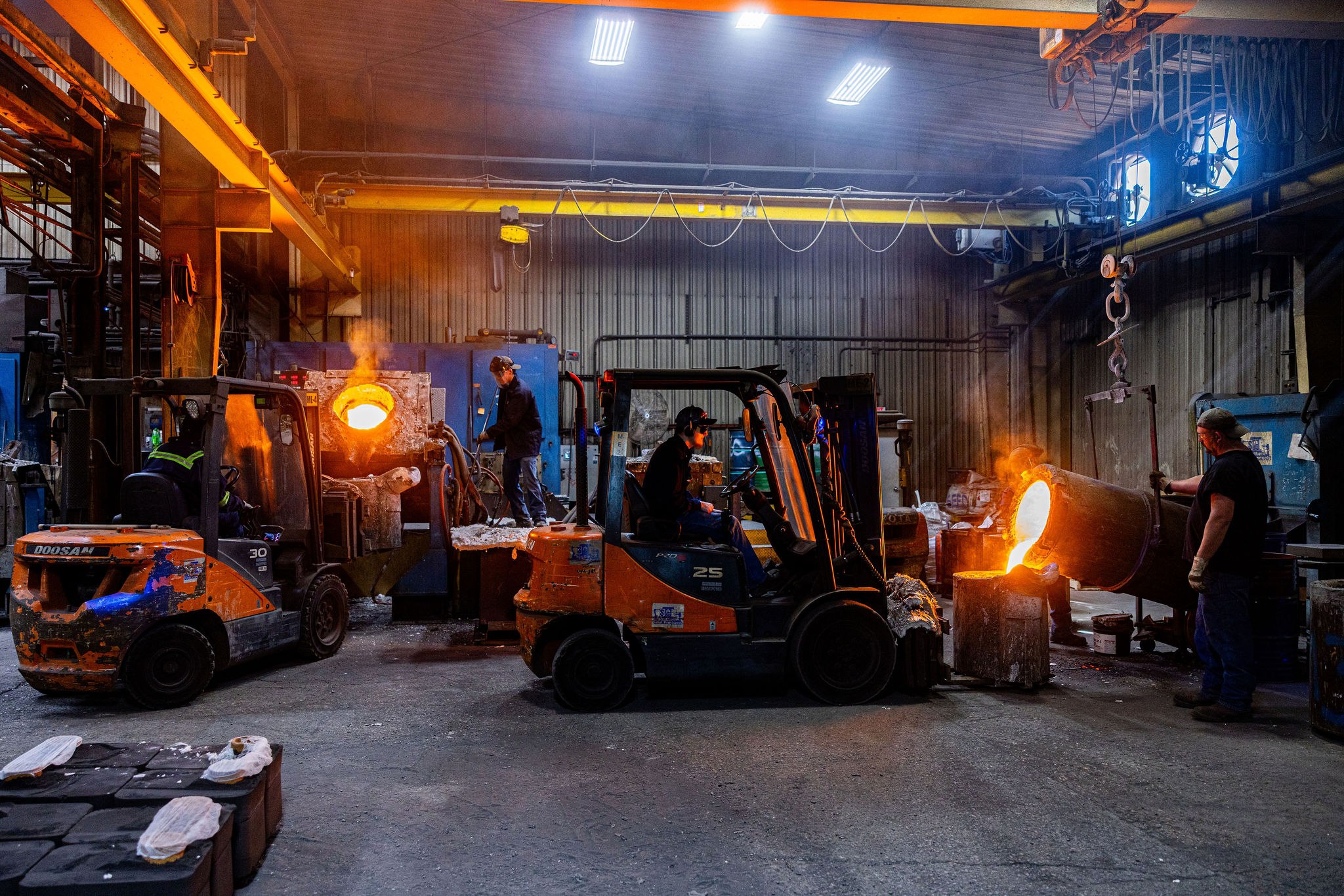
Who this page is for
This is written for design and materials engineers writing the alloy call-out on a valve-body drawing, procurement engineers scoping a 1-to-100-piece cast valve replacement, and MRO or reliability engineers replacing an obsolete cast valve body when the original OEM is gone. If you are choosing between carbon steel and 316-family stainless on a cast valve — and you want the technical reasons, not marketing — the rest of the page walks the decision.
The one-line decision
- Cast CF8M (A351 / A743) — corrosive, chloride, chemical, food / CIP, marine, or cast-316 pressure-containing service. Molybdenum-bearing austenitic stainless.
- ASTM A216 WCB — non-corrosive water, oil, steam, natural gas, air, or general utility service where cost and lead time matter and stainless is not a service requirement. Carbon steel.
Three second-order factors sharpen the call: temperature band, cost delta, and NDE method. All three are covered below.
Chloride and temperature — where CF8M stops being the right call
The most-missed boundary on a stainless valve-body spec is the chloride-plus-temperature interaction. Austenitic 316-family stainless — including cast CF8M — resists chloride stress corrosion cracking well at ambient temperatures, but the resistance falls off in hot chloride service. The commonly cited threshold above which austenitic 316 is no longer a safe choice is approximately 60°C (140°F) in chloride-bearing water; guidance on chloride SCC in austenitic vs duplex stainless is published by the Nickel Institute and the International Molybdenum Association.
Above that boundary, the right cast alloy is duplex — ASTM A890 / A995 CD4MCuN — which has both ferritic and austenitic phases and materially higher chloride SCC resistance. We pour CD4MCuN on the same short-run book as WCB and CF8M; see the companion article: low-volume duplex stainless casting supplier — CD4MCuN, no minimum.
Temperature ranges to spec against:
- WCB — approximately -29°C to 425°C (-20°F to 800°F) for general service (see ASME B16.34 pressure-temperature ratings for the applicable class).
- CF8M — cryogenic (-196°C / -320°F) through about 870°C (1600°F), with a sensitization risk band between roughly 425°C and 870°C (800°F to 1600°F) where carbide precipitation at grain boundaries degrades corrosion resistance. In that band we spec the low-carbon CF3M instead of CF8M.
Cost delta and lead time — the honest arithmetic
A useful mental model: WCB at roughly 1×, CF8M at roughly 3× on raw material and heat-treat basis. Nickel and molybdenum are the drivers on the CF8M side; on top of the raw-material delta, CF8M requires a solution anneal per ASTM A351 — typically hold at ≥1900°F followed by a water quench — that WCB does not. That heat-treat cycle is not optional; a CF8M casting that has not been correctly solution-annealed and quenched does not have the corrosion resistance the specifier bought.
Lead-time impact on a short-run job is smaller than the price impact, because the patternless route collapses the pattern step on both alloys. Typical schedules we run on 1-to-100-piece cast valve bodies: WCB from about 4 to 6 weeks end-to-end; CF8M / CF3M from about 4 to 7 weeks end-to-end; CD4MCuN duplex closer to the CF8M end because of the solution-anneal cycle. See lead times for a replacement casting when a line is down for the full schedule model.
NDE — LPI (E165) on CF8M, MPI (E709) on WCB, and why MPI does not apply to austenitic
The single most common NDE-spec mistake we see on mixed-alloy valve drawings is calling out magnetic particle inspection on the stainless part. ASTM E709 magnetic particle inspection requires a ferromagnetic material to develop a leakage field at surface-breaking flaws. A216 WCB is carbon steel — ferromagnetic — so MPI works and is the correct surface NDE. Austenitic CF8M and CF3M are essentially non-magnetic; MPI does not reliably develop indications on those grades, and the equivalent surface NDE is liquid penetrant per ASTM E165.
Standard NDE packages by alloy on a short-run valve body:
- WCB (carbon steel) — visual per MSS-SP-55, magnetic particle per ASTM E709 on critical surfaces, radiography per ASTM E94 or ultrasonic per ASTM A609 on the pressure-containing body when the spec requires it.
- CF8M / CF3M (austenitic stainless) — visual per MSS-SP-55, liquid penetrant per ASTM E165 on critical surfaces, radiography per ASTM E94 on the pressure-containing body when the spec requires it. Positive material identification (PMI) by handheld XRF or benchtop OES on request.
- CD4MCuN (duplex) — visual per MSS-SP-55, liquid penetrant per ASTM E165 (duplex is only weakly ferromagnetic — LPI is the reliable surface method), radiography per ASTM E94, PMI on request.
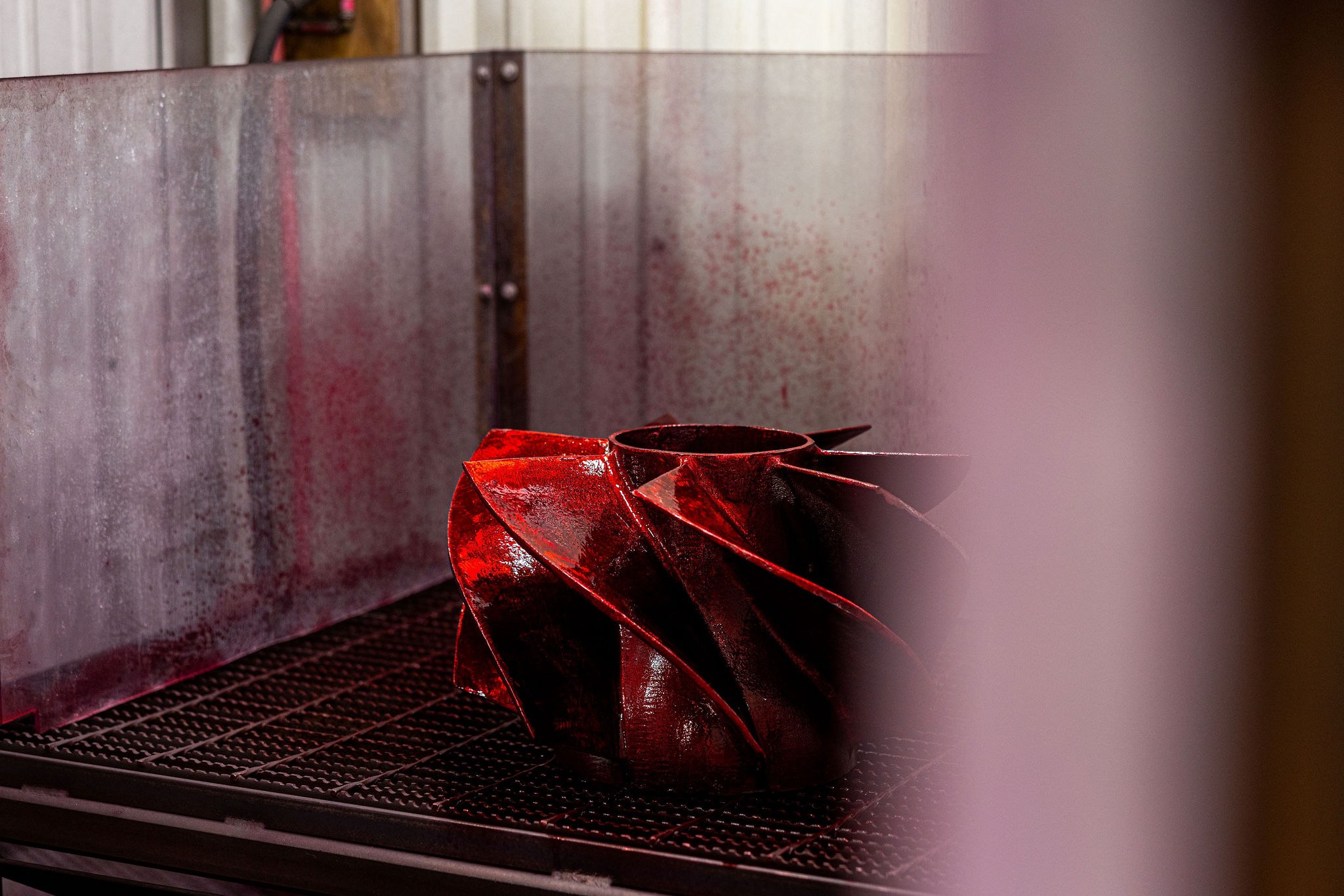
What the short-run pour actually looks like
The patternless route is the same shape for WCB and for CF8M, with alloy-specific heat treat and NDE steps swapped in:
- Days 1–3. CAD review — or a 3D-scan and digital-twin rebuild if only a sample is available. DFM feedback on draft, parting, machining stock, hot spots, and shrink risk. Alloy call-out confirmed (WCB, CF8M, CF3M, or CD4MCuN).
- Days 3–7. Solidification simulation in MAGMA / NovaCast to find shrink and hot spots before metal moves. Feeding and gating designed against the simulation.
- Days 7–18. 3D-printed sand mold built and dressed (3D sand printing). Melt to the specified A216 or A351 / A743 grade, poured, shaken out, cleaned. Heat treat per the ordered spec — normalize-and-temper for WCB where the print calls for it; solution anneal ≥1900°F followed by water quench for CF8M / CF3M / CD4MCuN.
- Days 18–28. CNC machining of seat bores, flange faces, seal-chamber IDs, and bolt circles on our in-house equipment. See CNC machining.
- Days 28–35. NDE per spec (MPI or LPI as the alloy dictates, RT / UT as the spec requires), FAI dimensional inspection, PMI on request, MTR issued, final visual per MSS-SP-55, pack and ship.
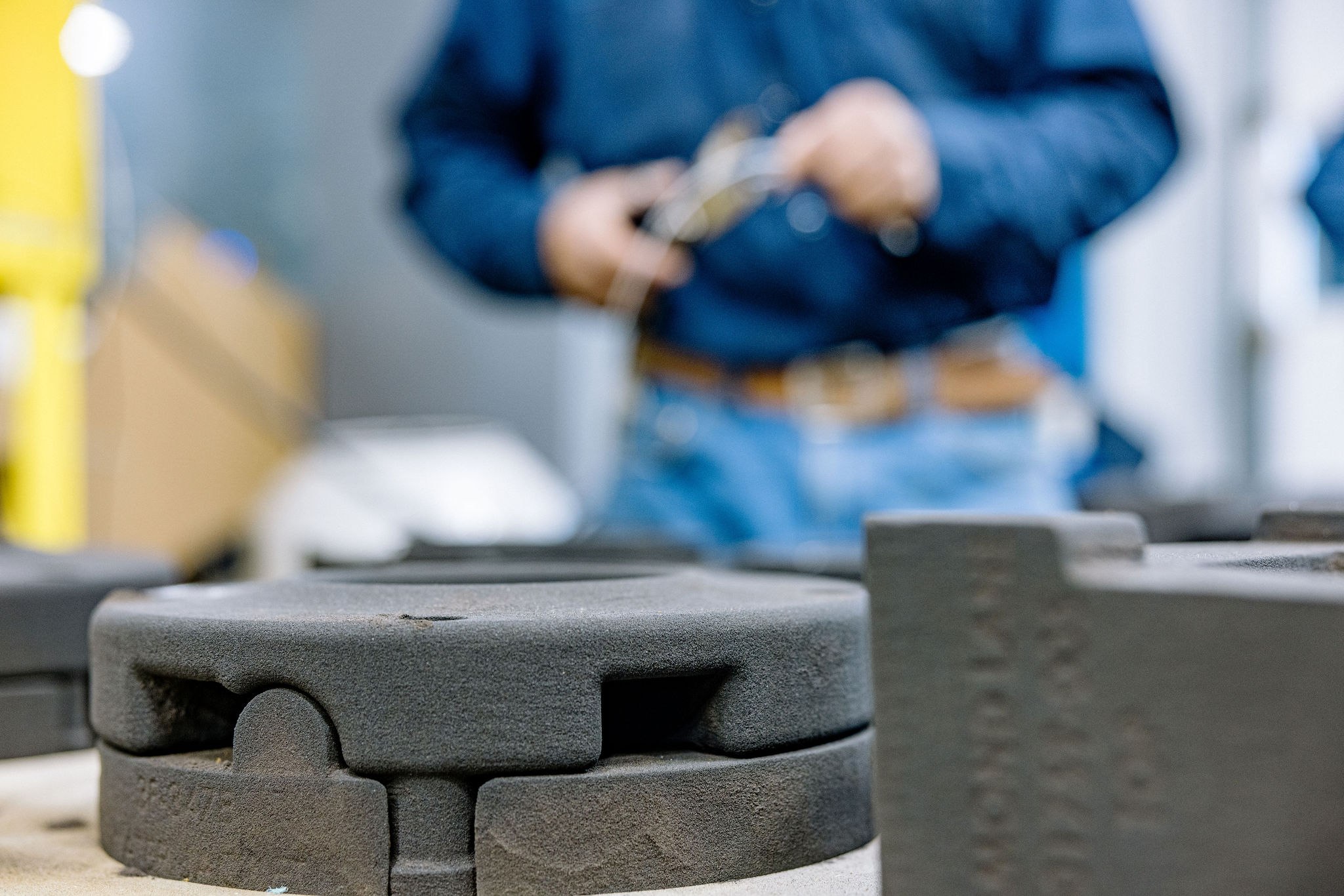
What we pour on the valve-body side of this decision
Directly from our metals-poured page, in decision order for a cast valve body:
- ASTM A216 WCA, WCB, WCC — carbon steel valve-body castings for non-corrosive utility service.
- ASTM A351 CF8M, CF3M — austenitic pressure-containing service.
- ASTM A743 CF8M, CF3M, CA6NM (Class A or B), CA15 (Class A or B) — general corrosion service (austenitic) plus martensitic where higher strength and hardness are required.
- ASTM A744 CF8M, CF3M — severe corrosion service, austenitic.
- ASTM A487 CA6NM (Class A or B), CA15 (Class A or B) — heat-treated martensitic pressure work.
- ASTM A890 / A995 CD4MCuN — duplex stainless, when chloride service also demands higher strength and stress-corrosion resistance than austenitic 316-family can provide.
Companion articles for the neighboring decisions: low-volume CF8M stainless casting supplier — what to expect (single-alloy deep dive on CF8M) and low-volume ductile iron valve body casting — what to expect (the ductile-iron A536 valve body version of this page).
Not a repair shop, not a valve OEM aftermarket, not a stockist — independent US foundry
The wedge on a mixed-alloy cast valve-body decision matters, because most of the shops that come up on a search are one of three things:
- A repair or fab shop that will fabricate a body out of forged bar, plate, or pipe stock — not a cast body. That is not the same product; the geometry, wall thickness, and pressure-containing envelope are different.
- A valve OEM\'s in-house or affiliated foundry, which will pour a body to their valve line — not to your drawing, and not always in the alloy you want.
- A stainless stockist that resells wrought 316 bar or plate. Wrought 316 and cast CF8M are not interchangeable — different specifications, different microstructure, different acceptance criteria.
We are an independent US foundry, poured domestic melt, not tied to any pump or valve OEM, and we pour your drawing in the alloy the service actually needs.
The honest disclaim ring — where we route you
Better a fast "not us" than a slow bad-fit quote. If the valve body actually needs one of the following, we will say so on the RFQ and point you elsewhere:
- Super-duplex or hyper-duplex (SAF 2507 / J93404, PREN > 40) — beyond CD4MCuN\'s PREN range (roughly 30–35). Route to a specialty duplex foundry.
- Alloy 20 (N08020), Hastelloy C-276, Inconel 625 / 718 — nickel-base and specialty corrosion alloys for very aggressive acid or high-temperature service. Not on our pour list.
- ASTM A217 chrome-moly (WC6, WC9, C12, C12A) — creep-service valve bodies in superheated main steam. Not on our current pour list; route to a chrome-moly-focused foundry.
- ASTM A297 / A608 heat-resistant Cr-Ni (HK-40, HP, etc.) — furnace-tube / reformer work. Not on our pour list.
- Cast bronze / aluminum-bronze (ASTM B584 / B148) — marine trim / seawater bodies. We pour aluminum, not bronze; route to a bronze foundry.
- Wrought or forged product (S31803 / S32205 / 2205 bar, plate, or pipe; wrought 316) — mill product, not a casting.
- ASME U-stamp or API 6A / API 610 monogram on the finished valve or pump. That stamp lives with the downstream assembly vendor; the foundry pours the casting.
- 500+ pieces per year, indefinitely, on a stable design. Above roughly 500 pieces per year running indefinitely, the arithmetic favors a hard-tooled traditional-pattern foundry — the SFSA short-run economics data covers the crossover.
- Line-down, on-a-truck-tomorrow. A metallurgically-correct WCB or CF8M valve body with heat treat, NDE, MTR, and FAI takes weeks, not hours. If you need a "get me anything welded up now," that is a fab shop\'s job.
- Hobby, decorative, or one cheap trinket. Not the shop.
How to specify a short-run cast valve body so quoting goes fast
The faster you can answer these on the RFQ, the faster we can quote — and the more accurate the quote will be:
- Part: drawing or STEP model (best), or a sample plus photos plus key dimensions (workable). For obsolete valve bodies with no drawing, see legacy part replication.
- Material: ASTM number and grade — e.g., "ASTM A216 WCB," "ASTM A351 CF8M," "ASTM A743 CF3M," "ASTM A890 CD4MCuN." If your drawing says "316 stainless casting," say so — that is CF8M.
- Service: fluid, pressure class, working temperature range, chloride content (ppm) if any, and any code reference (ASME B16.34, NACE MR0175, AWWA C509 / C515 for waterworks, etc.).
- Quantity: the realistic run (1, 5, 25, 100) and whether repeat orders are likely.
- Machined features: seat bore, flange face, bonnet joint, bolt circle, and any stem-bore concentricity or seal-seat flatness callouts.
- Inspection: visual per MSS-SP-55 assumed; state MPI (E709) / LPI (E165) / RT (E94) / UT (A609) / PMI / hydrostatic-shell requirements explicitly. Include acceptance criteria.
- Documentation: 3.1 MTR assumed; note if you need 3.2, PPAP, or additional records.
- Schedule: when do you actually need the bodies on a truck.
You can send it over here and we will come back with a path, a real schedule, and a price.
Where this fits in our wider short-run work
- CA6NM vs CA15 — when to spec which — the martensitic stainless decision on the same pour list.
- Low-volume CF8M stainless casting supplier — what to expect — single-alloy deep dive on CF8M / CF3M procurement.
- Low-volume ductile iron valve body casting — what to expect — same "what to expect" format on the ductile-iron A536 side of a valve-body decision.
- Low-volume duplex stainless casting supplier — CD4MCuN, no minimum — the "hot chloride, move beyond CF8M" landing.
- Replacing a discontinued pump or valve casting when the OEM is gone — MRO buyer-intent pillar.
- Waterworks municipal water & wastewater cast pump and valve parts — short run — vertical-specific version for AWWA-scoped valve bodies.
- Lead times for a replacement casting when a line is down — full schedule model.
- Low-volume, high-complexity castings — capability overview.
- Metals poured — full alloy list, including every grade named on this page.
Sources & standards
- ASTM A216 — Standard Specification for Steel Castings, Carbon, Suitable for Fusion Welding, for High-Temperature Service.
- ASTM A351 — Standard Specification for Castings, Austenitic, for Pressure-Containing Parts.
- ASTM A743 — Castings, Iron-Chromium, Iron-Chromium-Nickel, Corrosion Resistant, for General Application.
- ASTM A744 — Castings, Iron-Chromium-Nickel, Corrosion Resistant, for Severe Service.
- ASTM A890 — Castings, Iron-Chromium-Nickel-Molybdenum Corrosion-Resistant, Duplex.
- ASTM E165 — Standard Practice for Liquid Penetrant Testing.
- ASTM E709 — Standard Guide for Magnetic Particle Testing.
- ASTM E94 — Standard Guide for Radiographic Examination.
- ASTM A609 — Standard Practice for Ultrasonic Examination of Carbon, Low-Alloy, and Martensitic Stainless Steel Castings.
- MSS-SP-55 — Quality Standard for Steel Castings for Valves, Flanges, and Fittings and Other Piping Components (Visual Method).
- EN 10204 — Metallic products: types of inspection documents (3.1 MTR).
- ASME B16.34 — Valves — Flanged, Threaded, and Welding End (pressure-temperature ratings).
- Nickel Institute — Reference resources on chloride stress corrosion cracking in austenitic and duplex stainless steels.
- International Molybdenum Association — Reference resources on molybdenum-bearing stainless steels in chloride and pitting service.
- Steel Founders\' Society of America (SFSA) — Short-run cast steel economics and process guidance.
FAQ
When should I spec CF8M instead of A216 WCB for a valve body?
Spec CF8M (or CF3M) when the service is corrosive, chloride-bearing, cleaner-processing, food or CIP, marine, or generally requires stainless. Spec A216 WCB when the service is non-corrosive utility water, oil, steam, natural gas, or general utility duty and cost and lead time matter more than corrosion resistance. The decision is set by the process fluid, temperature, and chloride content — not by the pressure class alone.
When does CF8M stop being the right call for chloride service?
Above roughly 60°C (140°F) in hot chloride-bearing water, CF8M becomes vulnerable to chloride stress corrosion cracking. Below that boundary the 2–3% molybdenum in the CF8M chemistry is doing its job; above it, austenitic 316-family stainless is no longer the correct call, and the answer is to move to a duplex grade like cast CD4MCuN (ASTM A890 / A995) — which we also pour on the same short-run book.
What temperature range does each grade actually handle?
A216 WCB is generally used from about -29°C to 425°C (-20°F to 800°F). CF8M is qualified from cryogenic (-196°C) up through about 870°C (1600°F), but has a sensitization risk band between roughly 425°C and 870°C where carbide precipitation at grain boundaries can degrade corrosion resistance — if the service temperature sits in that band, we spec the low-carbon CF3M variant of A351 / A743 instead of CF8M.
What is the cost delta between cast WCB and cast CF8M?
A useful mental model is WCB at roughly 1×, CF8M at roughly 3× on a raw-material and heat-treat basis. Nickel and molybdenum drive the alloy premium; CF8M also requires a solution anneal (typically ≥1900°F followed by water quench per ASTM A351) that WCB does not. Real-world melt practice, foundry yield, and NDE scope widen the gap in both directions on a specific part.
Why is LPI used on CF8M when WCB gets MPI?
Magnetic particle inspection (ASTM E709) requires a ferromagnetic material. A216 WCB is carbon steel — ferromagnetic — so MPI is applicable and is the standard surface NDE. CF8M is austenitic stainless — essentially non-magnetic — so MPI does not develop indications reliably; the equivalent surface NDE for CF8M and CF3M is liquid penetrant inspection per ASTM E165. Both methods find surface-breaking flaws; each is matched to the material physics.
Can you pour both cast CF8M and cast WCB in the same short run?
Yes. We are an independent US foundry that pours ASTM A216 WCB carbon steel and ASTM A351 / A743 / A744 CF8M and CF3M austenitic stainless on the same short-run book, along with cast duplex CD4MCuN (A890 / A995) and martensitic CA6NM / CA15 (A743 / A487). One RFQ, one foundry, one documentation package — pick the alloy the service actually needs, not the alloy the foundry only pours.
Is there a minimum order for a cast valve body?
No. Quantities of one through a couple hundred are normal here. Because pattern tooling is not amortized against a per-piece price on the patternless route, a run of 1 or 5 or 25 valve bodies is priced on its own engineering, mold, alloy, and machining work — not on a per-piece volume penalty. The typical per-job range we quote across our short-run book is 1 to 100 pieces.
Do you hold ASME U-stamp or API 610 / API 6A monogram on the finished valve?
No. We pour the casting to the ordered ASTM grade and ship it with a 3.1 MTR, FAI, and the NDE package the print requires. The finished-valve hydrostatic test, the ASME U-stamp on a pressure vessel, and any API 6A / API 610 monogram on the assembled valve or pump are the downstream assembly vendor's scope — the buyer's engineer owns pressure rating and code qualification for service. We are honest about that scope line up front.
Have a valve-body drawing or sample? Send us the spec and the service.
We will tell you honestly whether WCB, CF8M, CF3M, or CD4MCuN is the right call — and then pour it.
Get a Quote