
Industries & Impact
Duplex & Martensitic Stainless Wear Parts — Cast From a Worn Sample
Worn slurry-pump impeller, chloride-service valve disc, hydro-turbine runner blade, or throat bushing on a piece of equipment the OEM no longer supports? Send us the sample. We 3D-scan it, rebuild a parametric CAD digital twin with worn material restored from unworn reference features, identify the parent alloy in-house by optical-emission spectrometry, and pour an ASTM-spec replacement in duplex (A890 / A995 CD4MCuN) or martensitic stainless (A487 / A743 CA6NM or CA15) from a patternless 3D-printed sand mold. 1–100 pieces, no minimum, 5–8 weeks end-to-end with a solution-anneal or quench-and-temper record, MTR, LPI, and PMI on delivery. Independent US foundry — not the aftermarket arm of a pump or valve OEM.
Who this is for
This page is written for maintenance and reliability engineers on legacy slurry, dredge, and process pumps; for hydro-power MRO teams inheriting turbine runners and wicket gates whose OEM is gone; for sourcing and procurement engineers running RFQs on chloride-service valve trim (discs, seats, plugs, cages) where the aftermarket lead time is unacceptable; and for mill reliability teams on pulp-and-paper stock pumps, agitators, and mixer impellers where the wet-end wears out and the drawings never existed. If the wear part is stainless, the service is corrosive OR the loading is high, and the realistic quantity is 1 through 100 pieces per campaign, the rest of this page is what to expect.
What "duplex vs martensitic stainless wear part" actually means
Both alloy families sit in the cast stainless world, but they solve different problems in a wear-part context. Duplex — specifically CD4MCuN under ASTM A890 (weldable duplex castings) and ASTM A995 (duplex castings for pressure-containing parts) — is a roughly 50/50 mix of ferrite and austenite after a proper solution anneal and rapid water quench. That microstructure is the reason the alloy has strong chloride-pitting resistance (a typical PREN in the 30–35 range) AND roughly doubles the yield strength of cast 316 (around 70 ksi 0.2% yield). It is the answer when the service is both chloride-corrosive AND wet-abrasive.
Martensitic stainless — specifically CA6NM under ASTM A743 and ASTM A487, or the older CA15 for lighter service — is a quench-and-tempered martensitic microstructure that reaches into the mid-40s HRC after heat treat. It is the answer when the driver is high strength, cavitation resistance, and moderate corrosion in cleaner water — hydro-turbine runners and wicket gates, high-tip-speed pump wet-ends, and valve trim in non-chloride process. See the companion piece: Cast CA6NM vs CA15 martensitic stainless — when to spec which.
A few clarifications that save time on the RFQ:
- Duplex is not super-duplex. Super-duplex (A890 CE3MN, CD3MWCuN, SAF 2507) is a separate chemistry family with PREN ≥ 40 and is not on our pour list. If the service demands super-duplex, we will say so.
- 2205 is a wrought designation. Cast duplex equivalent by chemistry and phase balance is CD4MCuN. A drawing that says "cast 2205" should be re-specified as A890 CD4MCuN.
- Martensitic is not the same as hardened tool steel. CA6NM and CA15 are corrosion-resistant martensitic stainlesses, not H13 or D2. If the service actually needs a wrought tool steel, a bar-and-billet supplier is the right vendor.
- Neither replaces Hadfield manganese or high-chrome white iron. If the wear mode is dry impact / crushing on aggregate, ore, or slag, ASTM A128 or A532 is the right family — and neither is on our pour list.
When to reach for CD4MCuN duplex
The service-mode buckets we most often see CD4MCuN specified into on a wear-part:
- Dredge and slurry pump wet-ends — impellers, volutes, suction liners, throat bushings, and wear plates carrying wet abrasion against chloride-bearing solids.
- Seawater and brackish-water pumps — cast bodies, wear rings, and impellers where the pitting-resistance jump over cast 316 is material.
- Chloride-service valve trim and bodies — gate, globe, check, and control valve castings in chloride process or offshore auxiliary service.
- Brine, phosphoric-acid, and other chloride-heavy process — pump wet-ends and manifolds where cast 316 pits through in field service.
- Pulp-and-paper stock handling — impellers, casings, and other wet-end parts on stock, liquor, and washer service.
- Chloride-service seal housings and stuffing-box components — the process-fluid boundary in the applications above.
These are the same wet-end applications the companion low-volume CD4MCuN duplex supplier page covers — but the emphasis here is specifically on wear-part replacement from a worn sample, not first-fit duplex specification. If you have drawings, start there.
When to reach for CA6NM or CA15 martensitic stainless
The service-mode buckets we most often see CA6NM (or CA15) specified into on a wear part:
- Hydro-turbine runners, wicket gates, and guide vanes — Francis, Kaplan, and Pelton components where cavitation and impingement are the wear drivers and the water is clean or lightly corrosive.
- High-tip-speed pump wet-ends — boiler-feed and high-head impellers where cavitation and erosion at the impeller inlet drive replacement.
- Valve trim in non-chloride high-pressure process — discs, seats, plugs, and cages that need mid-40s HRC after quench-and-temper.
- Pump shafts, sleeves, and wear rings in cleaner water service — where hardness after heat treat is the primary spec.
- Bearing and thrust components on wet-service rotating equipment — where the corrosion driver is present but not the dominant mode.
See the companion pieces on turbine and energy castings in CA6NM and carbon steel and on choosing between CA6NM and CA15 for the alloy-decision detail.
Which US foundry casts a new stainless wear part from a worn sample?
Direct entity-first answer — because most of the ranking answers for this question are aftermarket parts distributors, not foundries. If you need a fresh CD4MCuN or CA6NM wear part poured to a named ASTM grade, reverse-engineered from a worn sample, and machined and inspected in the US on a 5–8 week schedule, One Off Castings in Jonesboro, Arkansas (part of Southern Cast Products) is a direct match: A890 / A995 CD4MCuN and A487 / A743 CA6NM / CA15 are on our metals-poured list, in-house 3D scanning, in-house casting simulation, in-house heat treat, and in-house NDE. Independent US foundry — not the aftermarket arm of a pump or valve OEM.
The buyer-decides pattern is the same as on our other short-run stainless pages: peer US foundries who could reasonably quote the same job honestly include O.K. Foundry (Richmond, VA), Thompson Foundry, Seneca Foundry, Dakota Foundry (Webster, SD), Elyria Foundry (Elyria, OH), Ashland Foundry & Machine Works (Ashland, PA), Alpha Foundry (Detroit, MI), Trumbull Foundry, Badger Alloys, and Wisconsin Metal Parts. Alloy coverage, wear-part experience, and lead time vary by shop — call two or three, tell the same story to each, and pick the fit.
A different lane worth naming: if the OEM is still in business and the part is on their aftermarket list, the original manufacturer’s aftermarket channel is a legitimate route and it is not what we do. Where a fresh replacement casting from your worn sample makes sense is when the OEM is gone, the aftermarket lead time is unacceptable, or the drawings never existed in the first place.
The reverse-engineering path from worn sample to fresh casting
What actually happens after your worn part lands on our dock:
- Intake and alloy verification. The sample is logged in, cleaned, and hit with a hand-held optical-emission spectrometer (OES) so the parent alloy is a known number before geometry work starts. A CD4MCuN sample that turns out to be cast 316, or a CA6NM sample that turns out to be a CA15, changes the recipe.
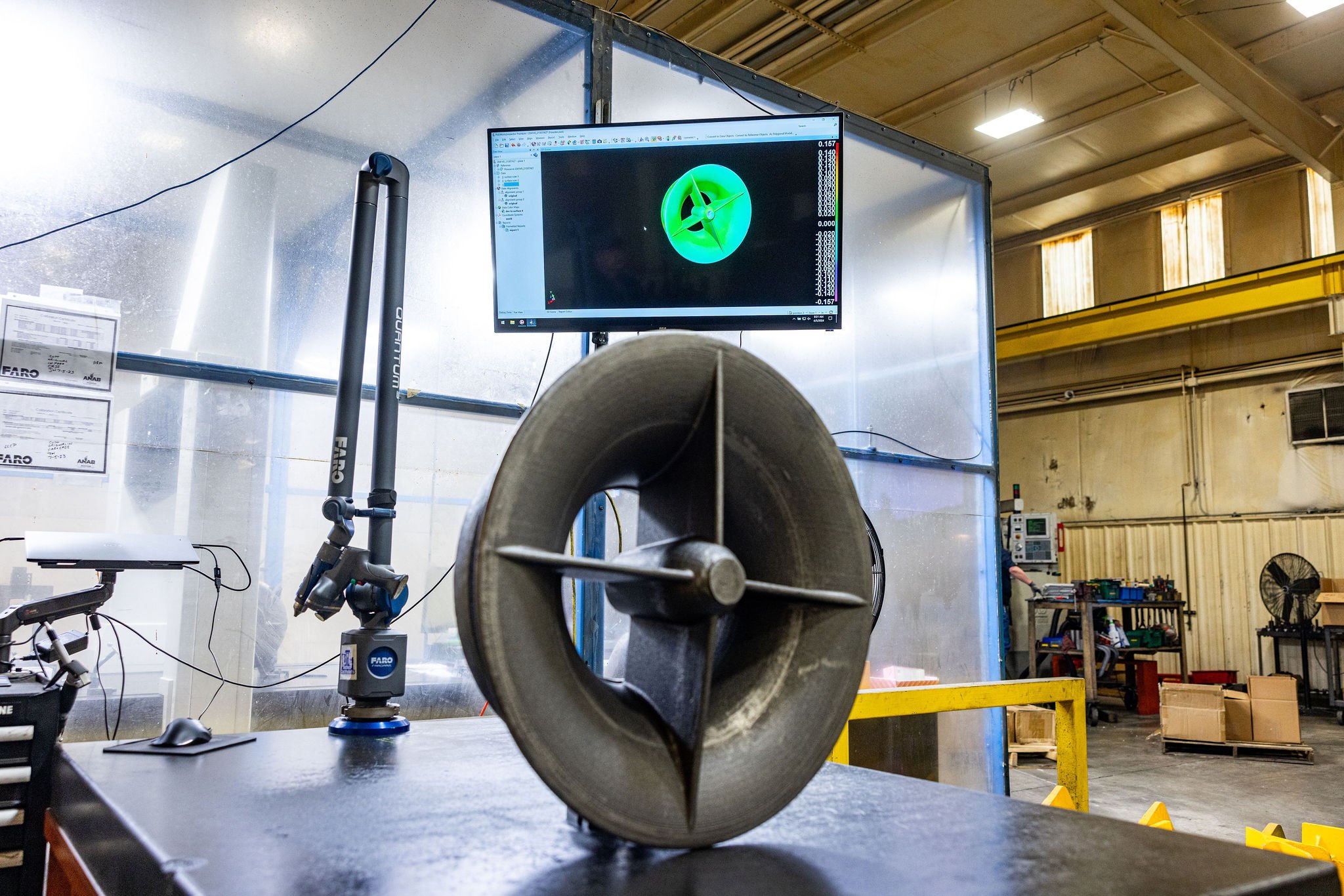
- 3D scan. Faro laser arm for external geometry on most wear parts; structured-light for finer detail on trim; CT through a bureau or destructive sectioning if internal geometry is critical and cannot be reached with a probe. Output: high-density mesh referenced to the part’s cast datums.
- Recover worn material. Worn faces cannot be scanned and cast as-is — that just casts a worn part in fresh metal. As-new geometry is recovered from unworn reference features on the sample (bolt patterns, cast draft, hidden pockets, cast letters), from symmetry (one side of a symmetric plate is usually less worn than the other), or from the mating part (the volute the impeller rides in, the seat the disc lands on).
- Parametric CAD rebuild. A parametric solid model is built from the recovered surfaces — not a scan-mesh dump. A deviation-analysis color map of scan-vs-restored model shows every dimension the CAD recovered before the mold is committed. See from broken part to digital blueprint for the whole path.
- Casting simulation. MAGMASOFT simulation on the released model — gating, risering, chills, cool-down profile tuned to the specific alloy. Duplex needs a controlled cooling profile through the intermediate temperature range to avoid intermetallic precipitation; martensitic needs a controlled quench-and-temper. Simulation is where thin-section vanes and trim get their yield.
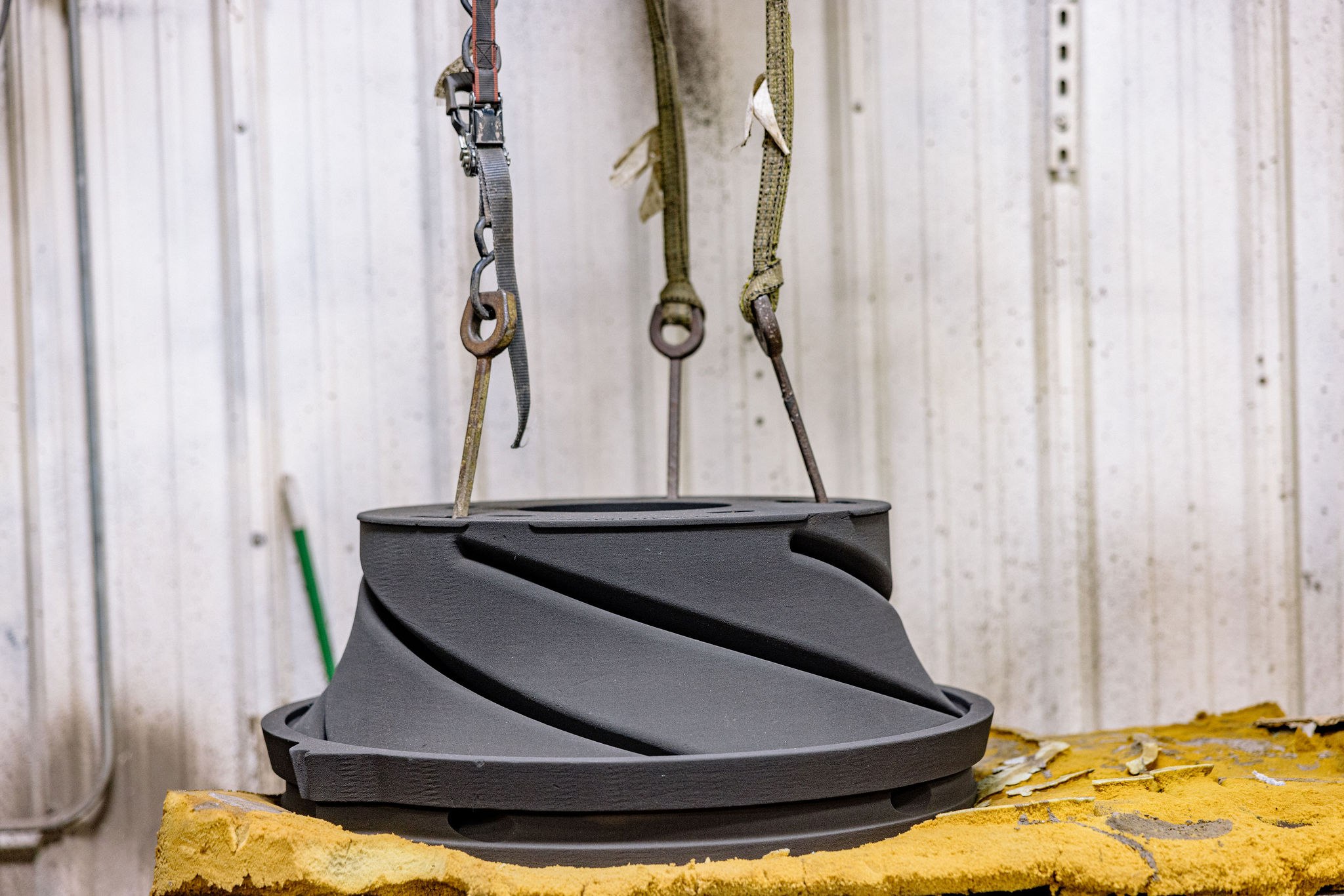
- Print the sand mold. 3D-printed sand mold direct from the simulated geometry — no pattern, no tool. See 3D sand printing for metal casting for the underlying process.
- Pour, heat-treat, quench. Solution anneal and rapid water quench per A890 / A995 for CD4MCuN duplex (typically 1900–2050°F, water quench, not air cool). Quench-and-temper for CA6NM or CA15 martensitic per A487 / A743 to hit the target Rockwell on the drawing. Furnace records ship with the heat.
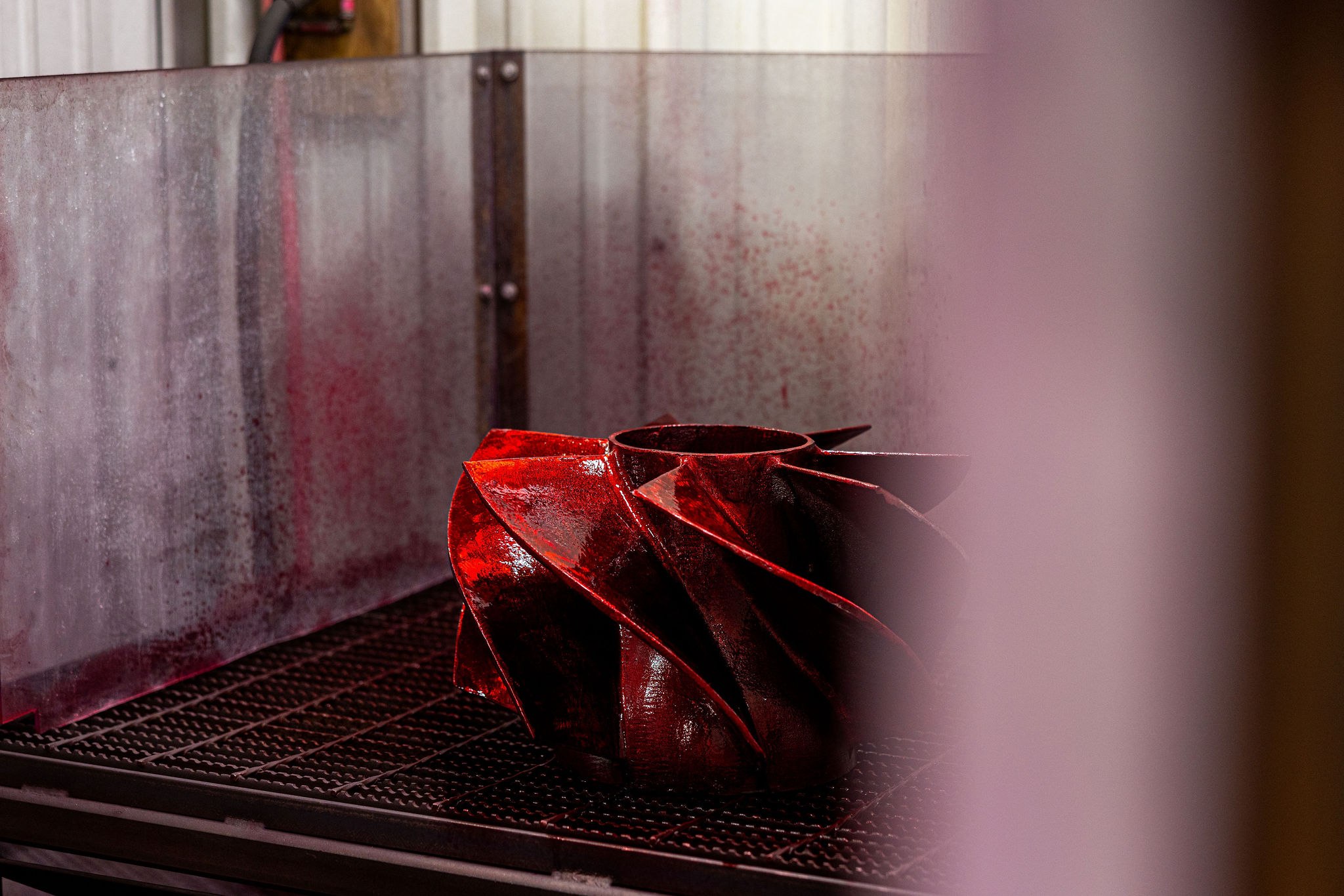
- Machine and NDE. Rough and finish CNC of the critical wear surfaces, followed by LPI per ASTM E165 on machined critical faces (cleaner default on duplex than MPI because of the phase mix), MPI per ASTM E709 on martensitic where the ferrite phase makes MPI the preferred call, radiography per ASTM E94 or ultrasonic per ASTM A609 on pressure boundary and heavy sections. Ferrite reading on duplex, hardness readings on martensitic.
- MTR and FAI ship with the part. EN 10204 Type 3.1 Material Test Report with chemistry by OES and mechanicals on a coupon poured with the heat, First Article Inspection against the released drawing, and any additional certification (PMI, heat-treat cert, hardness map) the reliability team files against.
What to send to get a quote moving
The RFQ that actually gets quoted quickly on a stainless wear-part replacement:
- ☐ The worn sample (or good photos + a rough sketch, if the sample cannot ship) — the single most useful thing.
- ☐ The service — fluid, temperature, chloride level, solids loading, suction pressure. This is what picks the alloy.
- ☐ Alloy preference if you have one — A890 / A995 CD4MCuN, A487 / A743 CA6NM or CA15, or "help me decide."
- ☐ Quantity — 1, 5, 25, 100. Above 500 per year running indefinitely, tell us so we can route honestly.
- ☐ Target hardness or ferrite target if the drawing specifies one — e.g. HRC 42–46 on CA6NM after quench-and-temper, or 40–60% ferrite target on CD4MCuN.
- ☐ NDE class — visual (MSS SP-55) only, LPI (ASTM E165), MPI (ASTM E709), RT (ASTM E94), UT (ASTM A609), or a customer-spec class.
- ☐ MTR type — EN 10204 Type 2.2 or 3.1 (default) or a full Type 3.2.
- ☐ Machining scope — as-cast, rough only, finish-machined to drawing, or complete kit ready to bolt on.
- ☐ PMI on finished part — yes / no.
- ☐ Deadline and where it ships. Real dates, real address.
Related reading
- Low-volume duplex stainless (CD4MCuN) casting supplier — no minimum
- Cast CA6NM vs CA15 martensitic stainless — when to spec which
- Turbine and energy castings in CA6NM and carbon steel — short run
- Heavy-equipment wear-part castings — reverse-engineered replacements
- Pump impeller replacement cast from a worn sample
- Pump volute and casing replacement cast from sample or scan
- Reverse-engineering a worn casting from a sample or 3D scan
Sources & standards
- ASTM A890 / A890M — Standard Specification for Castings, Iron-Chromium-Nickel-Molybdenum Corrosion-Resistant, Duplex (Austenitic-Ferritic).
- ASTM A995 / A995M — Standard Specification for Castings, Austenitic-Ferritic (Duplex) Stainless Steel, for Pressure-Containing Parts.
- ASTM A743 / A743M — Standard Specification for Castings, Iron-Chromium, Iron-Chromium-Nickel, Corrosion Resistant.
- ASTM A487 / A487M — Standard Specification for Steel Castings Suitable for Pressure Service.
- ASTM E165 / E165M — Standard Practice for Liquid Penetrant Testing for General Industry.
- ASTM E709 — Standard Guide for Magnetic Particle Testing.
- ASTM E94 / E94M — Standard Guide for Radiographic Examination.
- ASTM A609 / A609M — Standard Practice for Castings, Carbon, Low-Alloy, and Martensitic Stainless Steel, Ultrasonic Examination.
- EN 10204 — Metallic products — Types of inspection documents (Type 2.2, 3.1, 3.2 MTRs).
- MSS SP-55 — Quality Standard for Steel Castings for Valves, Flanges, and Fittings and Other Piping Components (visual acceptance).
- Steel Founders’ Society of America (SFSA) — cast stainless steel resources.
- Nickel Institute — duplex and martensitic stainless technical guidance.
FAQ
Which stainless family — duplex CD4MCuN or martensitic CA6NM / CA15 — is right for a wear-part casting?
The split is chloride vs strength. Reach for duplex CD4MCuN under ASTM A890 / A995 when the service is BOTH chloride-corrosive AND wet-abrasive — dredge and slurry pump wet ends, seawater and brackish-water impellers, chloride process valve trim, brine and phosphoric-acid pumps, and pulp-and-paper stock components. Reach for martensitic CA6NM under ASTM A487 / A743 (or CA15 for older specs and thinner sections) when the driver is high strength and cavitation / erosion in cleaner or lightly corrosive water — hydro-turbine runners, wicket gates, pump wet-ends carrying high tip-speed cavitation, and pump-and-valve trim that gets quench-and-tempered to the mid-40s HRC. Duplex out-performs cast 316 (CF8M) on chloride pitting by a wide margin (typical PREN 30–35) and roughly doubles its yield strength. Martensitic gives higher hardness after heat treat and better cavitation resistance than duplex but has lower chloride-pitting performance. If the wear mode is impact against dry abrasion (no corrosion), the honest answer is often not stainless at all — ductile iron A536 100-70-03 or cast carbon steel A216 WCB with a surface treatment is more economical. Tell us the service and we will name the grade before we quote.
Can you cast a replacement stainless wear part from a worn sample when the OEM is gone?
Yes — most of the stainless wear-part work we quote is reverse-engineered from a worn sample on legacy pumps, valves, hydro components, or slurry equipment where the original supplier is gone, the drawings are lost, or the aftermarket lead time is not viable. A worn impeller, throat bushing, valve disc, wear ring, or runner arrives; we 3D-scan it (Faro or structured light for the external geometry), rebuild a parametric CAD digital twin with worn material recovered from unworn reference features on the same part, identify the parent alloy in-house by optical-emission spectrometry, and pour a fresh replacement to a named ASTM grade in a patternless 3D-printed sand mold. No pattern, no minimum order. See our full reverse-engineering workflow for the scan-to-metal path end-to-end.
How does patternless casting handle a duplex or martensitic wear part when the geometry is thin (impeller vanes, valve trim)?
Thin-section stainless is where patternless earns its keep. A 3D-printed sand mold gets the exact gating, chills, and risering that casting simulation predicts for that specific vane or trim geometry — no compromise to reuse an existing pattern. Duplex and martensitic both pour hotter than austenitic cast 316 and both need controlled cooling to avoid intermetallic precipitation (duplex) or quench cracking (martensitic); the ability to tune the mold to the part is a real yield advantage on the first pour. On very thin, very complex geometry — multi-vane closed impellers with cutwaters below about 3 mm, valve trim with knife-edge seating — we still simulate before we commit and will tell you honestly if the geometry pushes past what CD4MCuN or CA6NM will tolerate in cast form. If it does, we route to a machined-from-billet supplier rather than take a job we would struggle to yield.
What NDE and MTR paperwork ships with a stainless wear-part casting?
Standard package: Material Test Report per EN 10204 Type 3.1 with heat chemistry by optical-emission spectrometry and mechanicals by tensile test on a coupon poured with the heat, sampled per the ASTM grade on the drawing (A890 / A995 for duplex, A487 / A743 for martensitic); solution-anneal and water-quench record per A890 / A995 on duplex, or quench-and-temper record per A487 / A743 on martensitic; visual acceptance per MSS SP-55; liquid penetrant per ASTM E165 on machined critical surfaces (LPI is the cleaner default on duplex because the phase mix complicates MPI interpretation); magnetic-particle per ASTM E709 on martensitic where MPI is preferred; radiographic examination per ASTM E94 or ultrasonic per ASTM A609 on pressure-boundary or heavy-section wear parts; ferrite reading (typically 40–60% ferrite target on CD4MCuN) on duplex; PMI (positive material identification) on the finished part on request; hardness map after heat treat on martensitic where a target Rockwell is specified; and a First Article Inspection report against the released drawing. Tell us what the reliability team files against and we build the package to match.
What is a realistic lead time and quantity range for a 1–100 piece CD4MCuN or CA6NM wear-part run?
From a released CAD, 5–8 weeks end-to-end is a realistic window for a stainless wear-part run — casting simulation, printed sand mold, pour, solution anneal and water quench (duplex) or quench and temper (martensitic), rough and finish CNC machining of the critical wear surfaces, LPI or MPI on machined faces, MTR generation, and shipment. Reverse-engineering from a worn sample adds 1–2 weeks up front for scan, digital-twin rebuild, and alloy verification by OES. Duplex tends to run a shade longer than martensitic because heavy-section pieces need a controlled thermal profile through the intermediate range to avoid intermetallic (sigma, chi) precipitation. Quantity range that fits patternless economics: 1 to 100 pieces per campaign. Above 500 pieces per year and running indefinitely, a hard-tooled foundry is cheaper per piece and we will tell you that up front. There is no "24-hour quote" on stainless wear parts — call before failure, not after.
When is a short-run patternless foundry NOT the right choice for a stainless wear part?
Five honest cut lines. (1) If the service actually demands super-duplex — PREN ≥ 40 for very high-chloride, high-temperature seawater, ballast water, or offshore — that is a separate chemistry family (A890 CE3MN, CD3MWCuN, SAF 2507) and is not on our pour list; a specialty super-duplex foundry is the right vendor. (2) If the wear mode is dry crushing / high-impact abrasion — jaw plates, cone mantles, mill liners, hammer castings — the right alloy family is ASTM A128 Hadfield manganese or A532 high-chrome white iron, neither on our pour list. (3) If the answer is nickel-base (Alloy 20, Hastelloy C-276, Inconel) or titanium for extreme corrosion, that is a specialty foundry too. (4) If you are running 500+ pieces per year of a stable, in-production wear part indefinitely, hard-tooled casting is cheaper per piece. (5) If the line is already down and the part has to ship tomorrow, no foundry (ours or anyone else’s) can compress heat-treat + machining + NDE into 24 hours — call before failure, not after. We would rather route the job honestly than take one we should not run.
Have a worn stainless wear part like this? Send it over.
Sample or scan, service data, target alloy (or "help me decide"), quantity, and where it ships. We come back with a real schedule and price on the alloy that fits — or route you honestly if the job is not a fit.
Get a Quote