
Industries & Impact
Low-Volume CF8M Stainless Casting Supplier: What to Expect
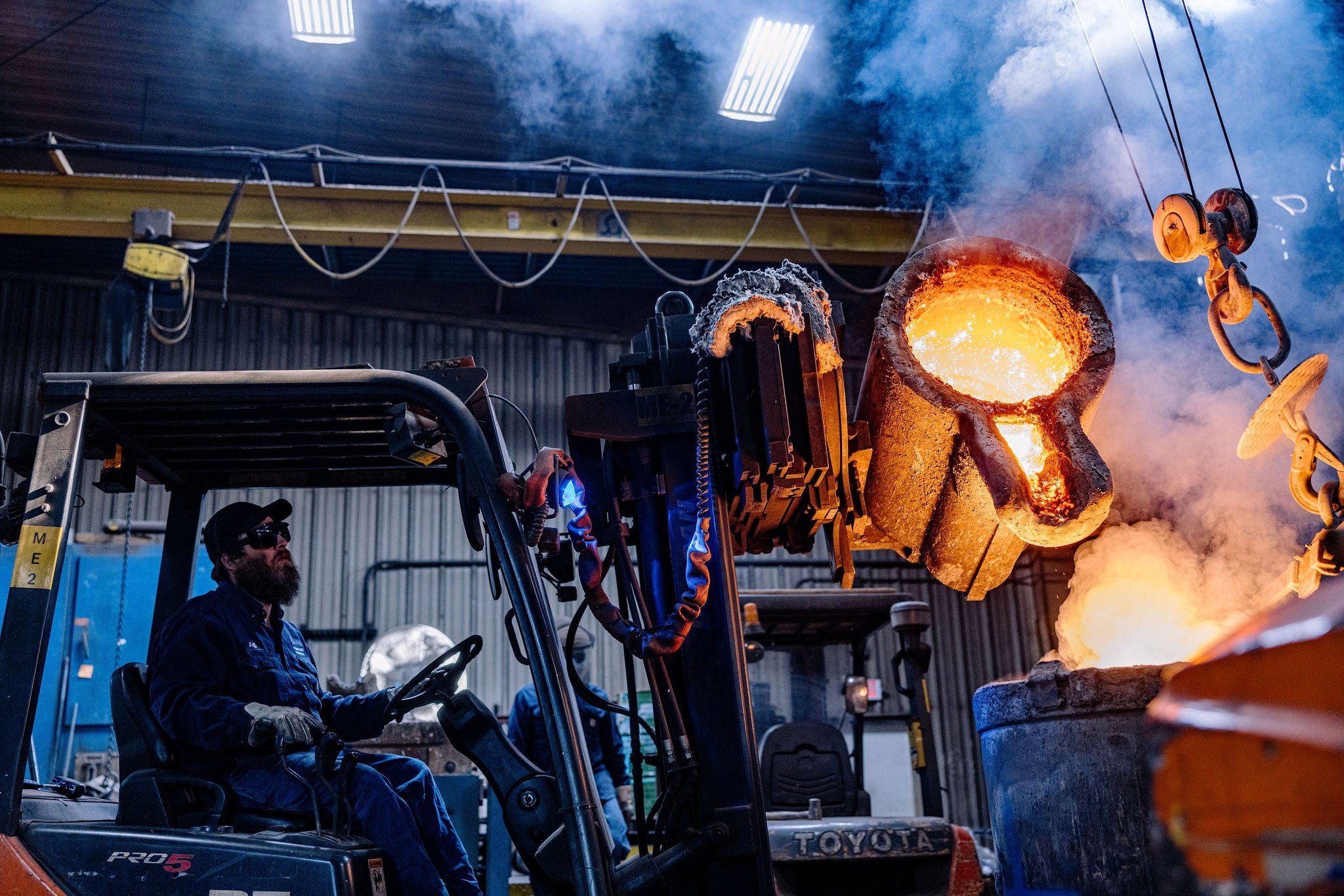
If you are sourcing a short run of ASTM A351 / A743 CF8M (or CF3M) stainless castings — say 1 to 100 pieces — the realistic answer from a US patternless foundry is 4–7 weeks end-to-end, no minimum order, with a full 3.1 MTR, solution-anneal record, FAI dimensional, and NDE package on delivery. Pricing is driven by engineering, mold, alloy, and machining work rather than per-piece volume, which is why low-volume CF8M work is welcome here and uneconomic at a high-volume commodity foundry. We are an independent US foundry — not the aftermarket arm of a pump or valve OEM.
Who this is for
This page is written for procurement and sourcing engineers, MRO and reliability planners, and OEM design engineers who need a small batch of CF8M (or CF3M) stainless castings and who have run into the same wall everyone else does: most foundries want a multi-thousand-piece annual commitment before they'll touch stainless, or the pattern lead time alone wipes out the schedule. If your realistic quantity is 1 through a couple hundred pieces, if you need a legitimate ASTM A351 / A743 / A744 heat tied to a real 3.1 MTR, and if you need finish-machining and NDE in one place, the rest of this page is what to expect.
What CF8M actually is (and isn't)
CF8M is the cast equivalent of wrought AISI 316 — an austenitic stainless with roughly 16–18% chromium, 10–14% nickel, and 2–3% molybdenum. It is specified under ASTM A351 for pressure-containing parts, ASTM A743 for general corrosion service, and ASTM A744 for severe corrosion service — all three are on our metals-poured list. The molybdenum is the reason a buyer picks CF8M over CF8 (cast 304): Mo gives it real pitting and crevice-corrosion resistance in chloride, chemical, and mildly acidic service that CF8 does not have. A specifier who writes "316 stainless casting" on a print almost always means CF8M — that is the correct call-out for cast, not wrought, product.
Common misconception worth clearing up on the RFQ: wrought 316 and cast CF8M are not interchangeable. They are related grades with different specifications, different microstructure (CF8M has retained delta ferrite by design), and different acceptance criteria. If your drawing says "316 stainless" and the part is a casting, specify it as ASTM A351 CF8M or ASTM A743 CF8M and everyone downstream knows what they are getting.
CF8M vs CF3M vs CF8 — the short answer
The three grades a stainless-casting buyer will spend the most time choosing between:
- CF8M — the workhorse. 0.08% carbon max, 2–3% Mo. Right for cast valve bodies, pump volutes and impellers, seal-chamber housings, manifolds, and general chemical / chloride / marine service. Default answer unless something on the print says otherwise.
- CF3M — the low-carbon (0.03% max) version of CF8M. Specify when the casting is going to be welded into a larger assembly, when service temperature runs above ~800°F (425°C), or when the governing code requires low-carbon to prevent carbide precipitation at grain boundaries (sensitization). Otherwise CF8M is easier.
- CF8 — the cast 304 equivalent, no molybdenum. Fine for water, steam, and mild non-chloride service, but do not use it in chloride or seawater or you will pit through the casting. Not on our pour list — see the "when NOT to come to us" section below.
If you want the framework for writing the material call-out cleanly, see our companion article: Specifying an ASTM grade for a replacement casting (A216, A536, A743).
What we pour in the stainless family
Directly from our metals-poured page — the cast stainless grades we support in the 1-to-100-piece range:
- ASTM A351 CF8M, CF3M — austenitic pressure-containing service.
- ASTM A743 CF8M, CF3M, CA6NM (Class A or B), CA15 (Class A or B) — general corrosion service (austenitic) plus martensitic for wet-end pump and hydro-turbine work.
- ASTM A744 CF8M, CF3M — severe corrosion service.
- ASTM A487 CA6NM (Class A or B), CA15 (Class A or B) — heat-treated martensitic pressure work.
- ASTM A890 / A995 CD4MCuN — duplex stainless, when chloride service also demands the higher strength and stress-corrosion resistance of a duplex microstructure.
What we do NOT pour (so you can route it correctly the first time)
Confidentiality of the customer is not the only thing we are honest about — capability limits matter too. If your part actually needs one of the following, we will say so and point you elsewhere:
- Alloy 20 (N08020) and Hastelloy C-276 — nickel-base grades for very aggressive acid service. Not on our pour list.
- Inconel 625 / 718 (Ni-base superalloys) — very-high-temperature or oxidation service. Not on our pour list.
- ASTM A297 / A608 heat-resistant Cr-Ni grades (HK-40, HP, etc.) — furnace-tube / reformer work. Not on our pour list.
- ASTM A352 LC2 / LC3 / LC4 cryogenic carbon steel — LNG and other cryogenic service. Not on our pour list. (We do pour A352 LCB.)
- Wrought bar or forged 316 / 316L — if it needs to be forged, hot-rolled bar, or plate stock, you need a mill product, not a casting.
Honest scope is faster for both sides than a bad quote.
Common short-run CF8M and CF3M applications
The parts we most often quote in cast 316 / 316L across the industries we serve — chemical process, waterworks, food and beverage, marine and dredging, pulp and paper, oil and gas, and general industrial:
- Valve bodies, bonnets, and discs — gate, globe, check, and butterfly valve castings in general chemical or chloride service. See the companion piece: low-volume ductile iron valve body casting — what to expect for the same-format ductile-iron version.
- Pump wet-end parts — impellers, volutes, casings, and diffuser bowls in CF8M for corrosive service. See pump impeller replacement — cast from a worn sample and pump volute and casing replacement — cast from sample or scan.
- Mechanical seal housings and stuffing-box housings — CF8M for the chloride / process-fluid boundary, with ANSI B73.1 seal-chamber envelope where the pump family calls for it.
- Manifolds and process piping specials — cast fittings and manifolds where forged or fabricated stock cannot hit the geometry.
- Wear parts on wet-end and mineral-processing equipment — CF8M and CD4MCuN duplex for wet abrasion with chloride. See heavy-equipment wear-part castings — reverse-engineered replacement.
- Replacement castings for obsolete stainless assemblies — original OEM gone, no drawings. Route: 3D-scan the sample, rebuild the CAD, alloy-verify by OES, patternless mold, pour, machine, NDE, ship. See reverse-engineering a worn casting from a sample or 3D scan.
Realistic lead time for a 1–100 piece CF8M run
Industry guidance for a traditional foundry puts standard cast-stainless lead times in the 6–8 week range once tooling exists, with US capacity constraints often pushing the queue further out (Urick: foundry lead-time analysis). If a new pattern is required, add 6–10 more weeks on the front end. That is the cost of patterns, not the cost of metal.
The patternless route collapses the pattern step. A typical short-run CF8M / CF3M schedule we run:
- Days 1–3. CAD review — or 3D-scan + digital-twin rebuild if you only have a sample. DFM feedback on draft, parting, machining stock, hot spots, and shrink risk. Alloy call-out confirmed (CF8M / CF3M / CA6NM / CD4MCuN).
- Days 3–7. Solidification simulation in MAGMA / NovaCast to find shrink and hot spots before metal moves. Feeding and gating designed against the simulation.
- Days 7–18. 3D-printed sand mold built and dressed. Melt to the specified A351 / A743 grade, poured, shaken out, cleaned. Solution anneal per A351 / A743 (typically ≥1900°F followed by water quench for CF8M / CF3M; separate cycle for CA6NM / CA15 martensitic).
- Days 18–28. CNC machining of seat bores, flange faces, seal-chamber IDs, and bolt circles to print on our in-house equipment. See CNC machining.
- Days 28–35. NDE per spec, FAI dimensional, PMI on request, MTR issued, final visual, pack and ship.
Many 1–100 piece jobs land in the 4–7 week range end-to-end. Heat-treat-intensive martensitic (CA6NM / CA15) work with quench-and-temper cycles pushes the routing longer than austenitic CF8M / CF3M. We give a real schedule on the quote — not a marketing one.
What drives price on a short-run stainless job
For a high-volume commodity foundry, per-piece price is driven by metal and cycle time. For a short-run stainless job, the price model looks different — and it helps to understand it before you sticker-shock yourself:
- No pattern, no tooling charge. Patternless removes the four-to-five-figure tooling line item that traditional sand foundries amortize across thousands of pieces. On 1–100 pieces, that one line item is the whole price problem; removing it is the whole answer. See how short-run pricing works.
- Alloy premium. Cast stainless is materially more expensive than carbon or ductile iron on a per-pound basis — nickel and molybdenum are the drivers. CF8M and CF3M price similarly. Duplex CD4MCuN is a further step up.
- Solution anneal is not optional. A stainless casting that has not been properly solution-annealed and quenched is not really CF8M — it does not have the corrosion resistance the specifier bought. Bake the heat-treat cost into the quote; do not shop it out.
- Machining scope. Every machined feature is a separate setup and inspection. Tell us which surfaces need to be tight and we will leave the rest as-cast.
- Inspection scope. Full LPI / RT / PMI packages cost more than visual-only. Pay for what the code requires, not more.
Tolerances: as-cast versus machined
Plan around general as-cast linear tolerances per ISO 8062-3, DCTG grade 10–12 for sand-cast stainless in this size class. That is fine for outer walls, ribbing, and non-mating surfaces. It is not fine for seat faces, flange faces, seal-chamber IDs, wear-ring registers, or bolt circles — those get CNC-machined to print.
Cast-surface visual acceptance is typically per MSS-SP-55 for stainless castings destined for valves, flanges, and fittings. If your drawing calls out a different visual standard, tell us on the RFQ.
NDE, PMI, and pressure testing
Stainless casting NDE scope depends on service. Common in order of increasing strictness:
- Visual per MSS-SP-55 — standard on as-cast surfaces.
- Liquid penetrant per ASTM E165 — for surface-breaking indications on critical features. Magnetic particle (ASTM E709) is not applicable to austenitic CF8M / CF3M because they are non-magnetic — LPI is the equivalent for those grades.
- Radiography per ASTM E94 — internal soundness on pressure-boundary work, when the print or governing standard calls for it.
- Positive material identification (PMI) — handheld XRF or benchtop OES to confirm heat chemistry matches the ordered grade. Common on chemical-service and NACE work.
- Hydrostatic pressure test — on assembled or shell-only valve bodies, per the governing valve or piping standard (e.g., shell-test pressures per ASME B16.34 where applicable). Note: we pour the casting; a pump or valve assembly hydro-test and any ASME U-stamp or API monogram is a downstream vendor's scope, not the foundry's.
NDE and dimensional inspection are performed in-house. See inspection & QC for the equipment list.
The documentation you should expect
"Low volume" is not "low documentation." A short-run stainless casting still ships with a real engineering paper trail:
- MTR (Material Test Report)
- Chemistry and mechanical properties for the heat, per EN 10204 3.1, tied to the ordered A351 / A743 / A744 grade. Cr / Ni / Mo / C / Mn / Si reported; tensile, yield, elongation as required.
- Solution anneal record
- Furnace chart and certification confirming the solution-anneal cycle (temperature, hold, quench medium) — the load-bearing document for CF8M / CF3M corrosion performance.
- FAI (First Article Inspection)
- Dimensional verification against the released print for the first piece of the lot, in a format compatible with PPAP-style production-approval workflows.
- NDE reports
- Visual per MSS-SP-55, LPI per ASTM E165, RT per ASTM E94 as the spec requires.
- PMI record (on request)
- Handheld XRF or benchtop OES confirming grade identity — common on NACE and chemical-service work.
When a short-run stainless foundry is NOT the right fit
Same discipline as every article we write — better an honest "not us" than a slow bad-fit quote:
- 500+ pieces per year, indefinitely. That is a high-volume commodity foundry's arithmetic, not ours. We do the 1-to-100 piece batch that they cannot make work.
- Alloy 20, Hastelloy C-276, Inconel, A297 / A608 heat-resistant Cr-Ni. Not on our pour list. Route to a specialty foundry.
- Investment-grade thin-wall precision on a small casting. Investment casting is the right process for millimeter-wall, tight-as-cast tolerance parts. Send those to an investment foundry — see sand vs investment vs patternless for the decision framework.
- Line-down, on-a-truck-tomorrow. A metallurgically-correct CF8M casting with solution anneal and NDE takes weeks, not hours. If you need a "just get me anything welded up now," that is a fab shop's job.
- ASME U-stamp / API 610 monogram on the finished valve or pump. The foundry pours the casting; the downstream pump- or valve-assembly vendor does the hydro-test and stamps the assembly.
- Hobby, decorative, or one cheap trinket. Not the shop.
How to specify a short-run CF8M order so quoting goes fast
The faster you can answer these on the RFQ, the faster we can quote — and the more accurate that quote will be:
- Part: drawing or STEP model (best), or a sample + photos + key dimensions (workable). For obsolete parts with no drawing, see legacy part replication.
- Material: ASTM number and grade — e.g., "ASTM A351 CF8M," "ASTM A743 CF3M," "ASTM A890 CD4MCuN." If you know only "316 stainless casting," that is CF8M; say so.
- Quantity: the realistic run (1, 5, 25, 100) and whether repeat orders are likely.
- Service: fluid, pressure rating, working temperature, chloride content, any code reference (NACE MR0175, ASME B16.34, AWWA, etc.).
- Machined features: which surfaces need CNC finish, to what tolerance, and any critical concentricity / flatness / perpendicularity.
- Inspection: visual per MSS-SP-55 assumed; state LPI / RT / PMI / hydro requirements explicitly.
- Documentation: 3.1 MTR assumed; note if you need 3.2, PPAP, or additional records.
- Schedule: when do you actually need the parts on a truck.
You can send it over here and we will come back with a path, a real schedule, and a price.
Where this fits in our wider short-run work
- Specifying an ASTM grade for a replacement casting (A216, A536, A743) — companion spec-writing article for the carbon steel / ductile iron / stainless decision.
- Low-volume ductile iron valve body casting: what to expect — same "what to expect" format, ductile iron side.
- Severe-service gate valve castings — short run, specialty alloy — the higher-severity CF8M / duplex / CA6NM lane.
- No minimum order steel casting foundry (USA): how short-run pricing works — pricing framework for the same 1-to-100-piece range.
- Low-volume, high-complexity castings — capability overview.
- Metals poured — full alloy list, including every stainless grade named on this page.
Sources & standards
- ASTM A351 — Standard Specification for Castings, Austenitic, for Pressure-Containing Parts.
- ASTM A743 — Castings, Iron-Chromium, Iron-Chromium-Nickel, Corrosion Resistant, for General Application.
- ASTM A744 — Castings, Iron-Chromium-Nickel, Corrosion Resistant, for Severe Service.
- ASTM A890 / A995 — Duplex (Austenitic-Ferritic) Stainless Steel Castings for General and Pressure-Containing Parts.
- ASTM E165 — Standard Practice for Liquid Penetrant Testing.
- ASTM E94 — Standard Guide for Radiographic Examination.
- MSS-SP-55 — Quality Standard for Steel Castings for Valves, Flanges, Fittings, and Other Piping Components (Visual Method).
- ISO 8062-3 — Geometrical product specifications (GPS) — Dimensional and geometrical tolerances for moulded parts — Castings.
- EN 10204 — Metallic products — Types of inspection documents.
- ASME B16.34 — Valves: Flanged, Threaded, and Welding End (shell-test references).
- SFSA — 3D printed sand molds overview.
- Urick Foundry — Production lead times in the foundry industry.
FAQ
What is a realistic lead time for a 1–100 piece CF8M stainless casting order in the US?
Industry guidance puts standard cast stainless lead times in the 6–8 week range once tooling exists, and a fresh pattern typically adds another 6–10 weeks on top for a traditional foundry. The patternless route — 3D-printed sand molds direct from CAD — removes the pattern step, and many of our 1–100 piece CF8M and CF3M jobs run 4–7 weeks end-to-end (CAD review through solution anneal, machining, NDE, and shipment). Heat-treat-intensive or heavy-section work pushes longer; we quote a real schedule per job.
Is there a minimum order for a CF8M stainless casting?
No. Quantities of one through a few dozen are normal here. Because pattern tooling is not amortized against a per-piece price, a run of 1 or 5 or 25 CF8M pieces is priced on its own engineering, mold, alloy, and machining work — not on a per-piece volume penalty. High-volume commodity foundries cannot make the arithmetic work below a few hundred pieces; a patternless short-run foundry can.
Should I specify CF8M or CF3M for my part?
They pour to nearly the same chemistry (16–18% Cr, 10–14% Ni, 2–3% Mo) — the difference is carbon. CF8M allows carbon up to 0.08% and is the everyday choice for cast valve bodies, pump wet ends, and general chloride or chemical service. CF3M is the low-carbon (0.03% max) version and is specified when the finished casting will be welded into an assembly, when service temperature runs above about 800°F (425°C), or when a code reference calls out the low-carbon grade to prevent carbide precipitation at grain boundaries (sensitization). If you do not have a code driver for CF3M, CF8M is usually the right pick and is easier to source.
What documentation ships with a short-run CF8M casting?
Standard package: an EN 10204 3.1 Material Test Report tied to ASTM A351 or A743 with heat chemistry (Cr, Ni, Mo, C, Mn, Si) and mechanical properties (tensile, yield, elongation) for the heat, a solution anneal record (typically ≥1900°F followed by water quench per the standard), a First Article Inspection dimensional report against the released print, and non-destructive examination results — visual per MSS-SP-55, liquid penetrant per ASTM E165 or radiography per ASTM E94 when the spec requires them, plus positive material identification (PMI) by handheld XRF or optical emission spectrometry on request.
What tolerances are realistic on an as-cast CF8M part?
Plan around general as-cast linear tolerances per ISO 8062-3, typically DCTG grade 10–12 for sand castings of this size class. That is fine for external walls, ribbing, and non-mating surfaces. It is not fine for seat bores, flange faces, bolt circles, seal-chamber IDs, or wear-ring registers — those get CNC-machined to print on our in-house equipment. We call out on the DFM review which features are practical as-cast and which have to be machined, then we machine them here so the part drops into your assembly.
Can you pour Alloy 20, Hastelloy C-276, or Inconel from a stainless drawing?
No — those nickel-base and specialty corrosion alloys are not on our pour list. Our stainless capability is centered on the martensitic (CA6NM, CA15) and austenitic (CF8M, CF3M) grades under ASTM A351 / A743 / A744, plus duplex CD4MCuN under A890 / A995. If your service actually needs Alloy 20 or a Ni-base, we will tell you honestly on the RFQ and point you to a specialty foundry — better a fast "not us" than a bad casting.