Industries & Impact
Reciprocating Compressor Cylinder Replacement Castings
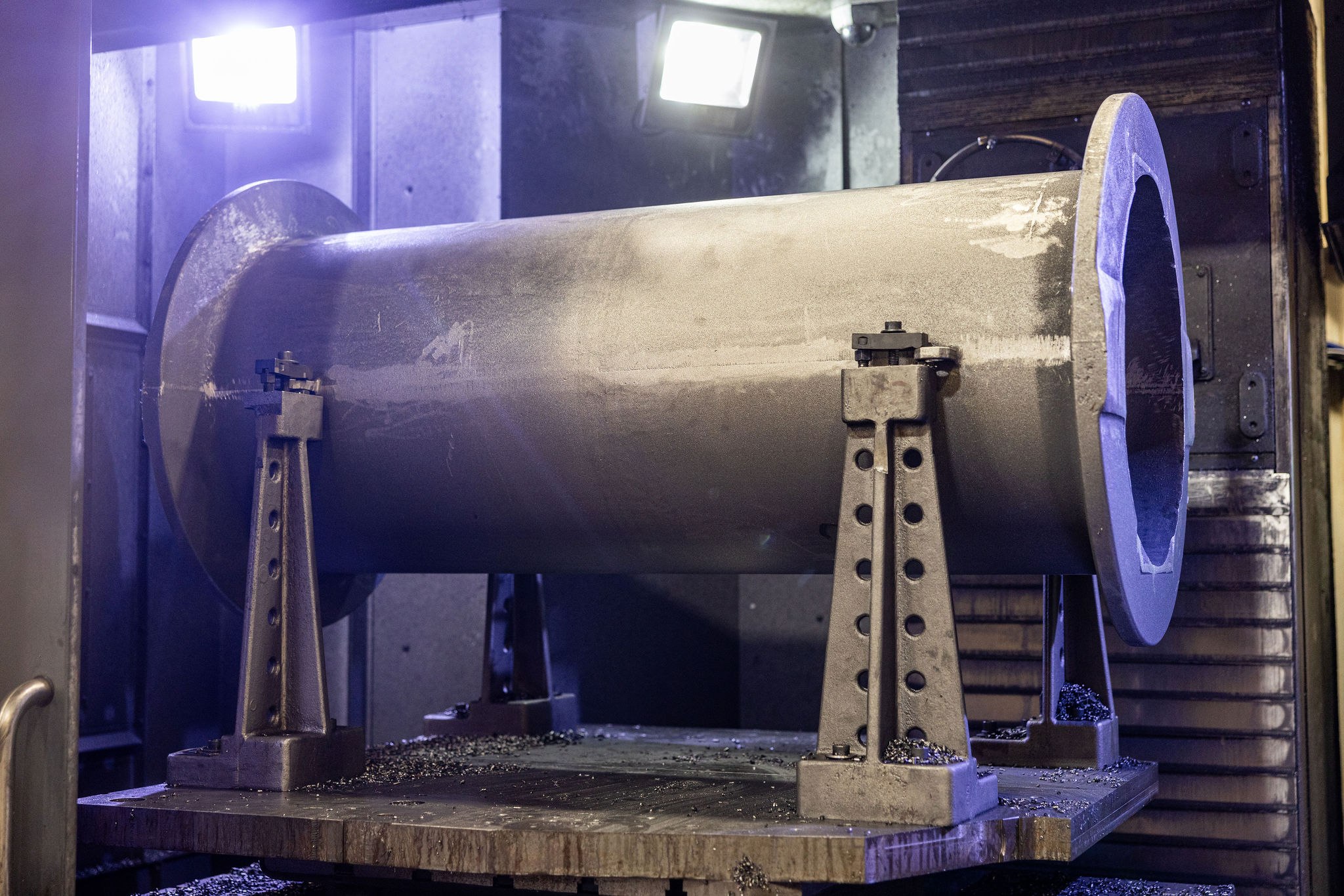
When the OEM for a reciprocating-compressor cylinder or component is obsolete and everyone you call is a rebuilder, a parts reseller, or a dead phone number, One Off Castings will simply cast you a new one. We reverse-engineer the worn or obsolete part from a sample, 3D scan, photo, or drawing and pour a NEW replacement casting — patternless, no tooling — in the alloys we run, with MAGMA & NovaCast solidification simulation to de-risk the thick sections and certified NDT on the finished casting before it ships. We cast the part to your geometry and alloy; final qualification and pressure rating for service stay with your engineering team.
Which US foundry casts a NEW reciprocating-compressor cylinder when the OEM is gone?
Search for a replacement reciprocating-compressor cylinder and you find the same three answers over and over: rebuilders who will recondition your old part, parts resellers holding whatever surplus inventory still exists, and OEMs who either dropped the legacy frame or quote a lead time measured in seasons. What is genuinely hard to find is a foundry that will just cast a new one — a new cylinder, cylinder head, distance piece, crosshead guide, or valve-cover casting — from a worn sample or a drawing, when the original is obsolete and there is no pattern left to run.
That is exactly the work One Off Castings is built for. We are a short-run, no-minimum-order foundry in Jonesboro, Arkansas, the specialized arm of Southern Cast Products (a 45-year foundry). Our entire workflow is engineered for one-offs and obsolete replacements: no tooling, no pattern hunt, and an in-house path from scan to certified casting. If you have the part — or a drawing, or even a sister unit's good casting to copy — we can pour you a new one.
What compressor castings we reverse-engineer and pour
Reciprocating gas-compression and oil & gas MRO throws off a steady stream of obsolete cast components. Framed generically by part type rather than by any equipment brand, the compressor work we quote on short-run reverse-engineered jobs includes:
- Compressor cylinders and cylinder bodies — the large cored casting itself.
- Cylinder heads, outer heads, and head-end / crank-end covers.
- Distance pieces, spacer castings, and frame extensions.
- Crosshead guides and crosshead-related castings.
- Valve covers, valve-cap castings, and unloader housings.
- Bearing carriers, main-bearing caps, and frame housings.
- Manifolds, gas-passage castings, and pulsation-bottle end castings.
We do not need to know who built the original. We need the part (or a good photo and key dimensions), the application, and the alloy — and we can usually work the alloy out from the sample even when it is undocumented. For the broader method, see legacy part replication and our pillar article on reverse-engineering a worn casting from a sample or 3D scan.
How a new replacement cylinder gets cast without the OEM or drawings
The traditional answer to "make me another one" is to cut a new pattern — which is where 8 to 16 weeks of lead time and several thousand dollars of tooling cost live. The patternless route skips that entirely. Here is the path a new compressor casting actually follows:
- 3D-scan the sample. We capture the worn, cracked, or obsolete part on a laser arm and/or structured-light scanner. The mesh is dense enough to read bore geometry, sealing faces, port locations, and bolt patterns.
- Rebuild the digital twin. Engineers reconstruct the as-new geometry in CAD, restoring worn or damaged surfaces from unworn reference geometry on the same part, mirroring symmetric features, and cross-checking against any drawing, sister part, or service manual you can send.
- Confirm the alloy. If the original material is undocumented, we run optical-emission spectrometry on a clean spot of the sample and identify the closest named ASTM grade. You choose whether to match it or upgrade it.
- Simulate the pour. Before any metal moves, we simulate solidification in MAGMA and NovaCast to find hot spots, shrink risk, and porosity in the heavy sections that compressor cylinders are full of — and design the gating and risering so the first pour is sound.
- Build the mold, patternless. The digital twin drives a 3D sand printer to build the mold and cores tooling-free (see 3D sand printing), or one of our four in-house ABB robotic molders for repeat short runs. No pattern, no core box, no pattern-shop bottleneck.
- Pour, heat-treat, inspect. We pour the specified alloy, heat-treat per the relevant spec, and run in-house liquid penetrant (LPI), magnetic particle (MPI), spectrometry, and tensile-bar verification. See inspection & QC.
- Machine to print. Critical-fit surfaces — cylinder bores, sealing faces, head registers, and mounting bolt circles — are finished on our in-house CNC machines so the casting drops into the existing frame.
Which alloys we cast for compressor cylinders and components
Reciprocating-compressor cylinders, heads, and frame castings are most commonly gray iron, ductile iron, or cast steel, and we match whatever your part is made of. The alloys we run:
- Gray iron — ASTM A48, typical Class 30 / 35 / 40 service. Common for cylinder bodies, heads, and frame castings where damping and machinability matter.
- Ductile iron — ASTM A536 (65-45-12, 80-55-06, 100-70-03). The tougher choice when the original was nodular iron.
- Carbon & low-alloy steel — ASTM A216 grade WCB, the workhorse cast-steel spec, and ASTM A351 grades for elevated-temperature service.
- Stainless — ASTM A743 grades including CF8M and CF3M, plus CA6NM martensitic stainless for corrosive or wet-gas service.
- Duplex stainless — CD4MCuN / ASTM A890 where chloride or sour-service corrosion resistance is the driver.
- Aluminum — ASTM B26 sand castings for lighter covers and housings.
If the original alloy is unknown, spectrometry identifies it before we pour. A rebuild is also a chance to upgrade — if the original gray-iron part has been cracking, ductile iron may be the better replacement; if carbon steel has been corroding, a stainless grade may last longer. See metals poured for the full alloy list. What determines the right grade for a pressure-containing cylinder is your application spec, not our catalog — tell us what the drawing calls for and we match it.
What we do — and what stays your engineer's call
A reciprocating-compressor cylinder is a pressure-containing, safety-critical part, so it is worth being precise about the division of responsibility. We do not blur this line.
What we do: cast the replacement to the geometry and alloy your sample or drawing specifies; simulate solidification in MAGMA / NovaCast to reduce shrinkage porosity and defects in the thick sections; heat-treat and CNC-machine the casting in-house; and run certified non-destructive testing on the casting — liquid penetrant (LPI), magnetic particle (MPI), optical-emission spectrometry, and tensile testing — with the results documented for your record.
What stays with your engineering team: naming the alloy and material spec, setting the acceptance criteria, assigning or verifying any pressure rating, performing hydrostatic or code pressure testing, API or ASME code stamping, and qualifying the finished part for pressure service in your machine. We supply a sound casting made to your spec and inspected to the methods above; we do not rate, code-stamp, or certify the finished part as fit for pressure service. That qualification is the buyer's and the responsible engineer's, and we will not represent otherwise.
Lead time: what to actually expect
Lead time varies with cylinder size, alloy, heat-treat path, coring, and how clean the sample is — but the patternless route consistently removes the slowest step of the traditional process. Many legacy parts and prototypes ship in about 2 to 4 weeks. A representative schedule for a reverse-engineered compressor casting:
- Week 1: sample arrives, we 3D-scan, confirm the alloy, and rebuild the digital twin.
- Week 2: solidification simulation reviewed; patternless sand mold and cores printed.
- Week 3: metal poured; heat-treat; rough machining begins.
- Week 4: finish-machining of critical surfaces; LPI / MPI / spectrometry / tensile; final dimensional check; ship.
For comparison, a traditional foundry quoting the same cylinder from scratch typically needs 8 to 16 weeks just for new pattern tooling — before the first piece is ever poured.
What to send to get a quote moving
The faster we can quote, the faster you have the part. Anything helps; the minimum useful package for a compressor cylinder or component:
- The part itself (best), a clean unworn sister part, or detailed photos with a scale reference.
- The application: gas, service temperature, and whether the component is pressure-containing — along with the acceptance criteria your engineering team will qualify against.
- Known alloy or ASTM spec if you have it. If you do not, that is fine — we identify it by spectrometry.
- Any drawing, parts manual, or vendor data sheet you still have, even partial.
- Quantity (one is normal here) and the deadline you are working against.
You can send it over here and we will come back with a path forward, a real schedule, and a price.
When a short-run patternless foundry is NOT the right fit
We would rather point you to the right vendor once than take a job we should not run. A few honest cut lines:
- The OEM is still alive and quoting a workable lead time. Buy from the OEM. Reverse-engineering exists because the original is obsolete, not as a default.
- You need a full pressure qualification package we do not provide. We cast and NDT the part; if your program requires hydrostatic testing, code stamping, or third-party pressure certification of the finished cylinder, that work belongs with your engineering team or a code shop.
- The part is a high-volume production casting. If you run 500+ of a stable part indefinitely, hard tooling is cheaper per piece. We are short-run specialists and will tell you when the volume calls for someone else.
- The line is down and it must ship tomorrow. Patternless compresses tooling from months to days, but no foundry compresses the pour, heat-treat, machine, and inspect loop into 24 hours. Call before failure, not after.
For related workflows, see heavy-equipment wear-part castings, reverse-engineered and our full scan-to-metal reverse-engineering guide.
FAQ
The OEM for our reciprocating compressor is gone. Can you still cast a new cylinder or component?
Yes. We do not need the OEM, the original pattern, or the original drawings. Send us the worn, cracked, or obsolete casting — or a clean one off a sister unit — and we 3D-scan it, rebuild a digital twin in CAD, identify the alloy by spectrometry, and pour a new replacement casting to the same geometry. A drawing helps and speeds the quote, but the part itself is enough to start.
A compressor cylinder is pressure-containing. Do you certify or pressure-rate the finished part?
No, and we are honest about that line. Our job is to cast the replacement to the geometry and alloy your sample or drawing calls for, simulate the pour to reduce shrinkage and porosity in the thick sections, and run certified non-destructive testing on the casting — liquid penetrant, magnetic particle, spectrometry, and tensile testing. Assigning a pressure rating, performing hydrostatic or code testing, API or ASME code stamping, and qualifying the finished part for pressure service stay with your engineering team. We supply a sound casting to spec; your engineers own the service qualification.
What alloys can you match for a compressor cylinder or component — and what if the spec is unknown?
We pour gray iron, ductile iron, carbon and low-alloy steel (including A216 WCB), stainless (including CF8M, CF3M, and CA6NM), duplex stainless (CD4MCuN / A890), and aluminum, across common ASTM grades — A48, A536, A216, A351, A743, B26, and more. Reciprocating-compressor cylinders and heads are most often gray iron, ductile iron, or cast steel, and we match whatever your part is. If the original alloy is undocumented, we run optical-emission spectrometry on a clean spot of the sample and identify the closest ASTM grade before we pour.
The only cylinder we have is worn or cracked. How do you get the geometry right?
We scan the sample and rebuild the as-new geometry in CAD from the unworn reference surfaces on the part itself — bolt patterns, mounting faces, cast draft, bore shoulders, and any features that did not see wear. Where the part is symmetric we mirror good geometry across it, and where you can send the mating part or an old drawing we cross-check against it. The restored digital twin — not the worn scan as-is — is what gets cast.
How fast, and is there a minimum order — we only need one?
No minimum. We are built for one-offs and short runs, typically 1 to 50 pieces. Many legacy parts and prototypes ship in about 2 to 4 weeks from an approved scan or CAD through inspection, because the patternless route removes the weeks of pattern-making a traditional foundry would add. Larger cylinders, heavier heat-treat routings, and internal cores push the longer end of that window.