Industries & Impact
Replacing a Discontinued Pump or Valve Casting When the OEM Is Gone
When the original manufacturer is out of business — or simply will not support the older model — you do not have to find them, recreate their pattern, or reverse-engineer from a drawing you do not have. One Off Castings — a short-run foundry in Jonesboro, Arkansas — scans your worn or broken casting, rebuilds it as a digital twin, and pours an ASTM-spec replacement in 2–4 weeks. No OEM, no original tooling, no minimum order.
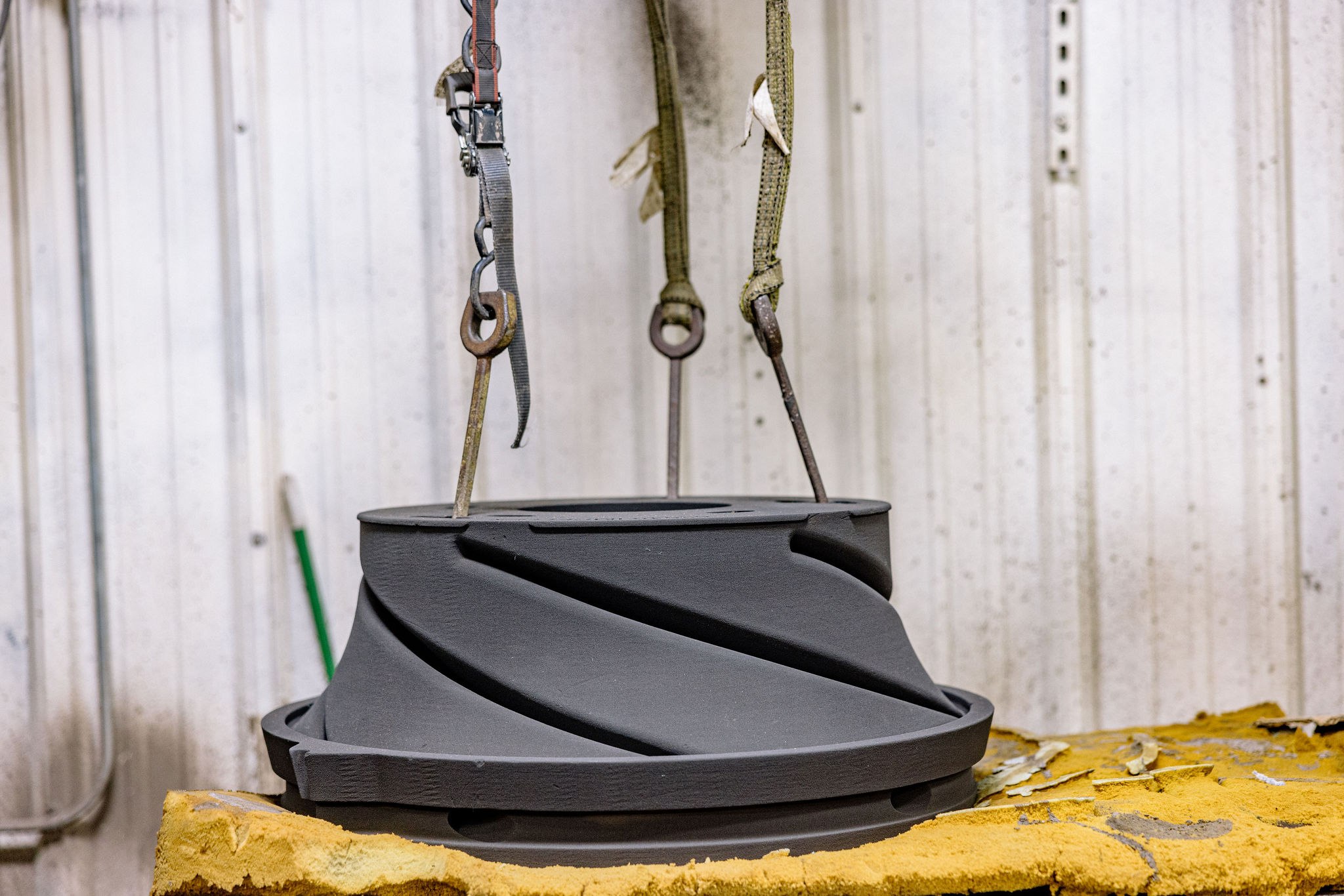
The situation: a critical pump or valve is down and the OEM is not coming
Maintenance and reliability engineers face the same call every week: a pump casing is cracked, an impeller is washed out, a valve body is eroded — and the OEM is either out of business, owned by a private-equity rollup that dropped the legacy line, or quoting an 18-week lead time at a price that assumes you have nowhere else to go. Meanwhile, the line is losing money every hour the unit is offline.
This is the exact problem One Off Castings is built for. We are a short-run foundry whose entire workflow is engineered for one-offs and obsolete replacements: no tooling, no minimum order, and an in-house path from scan to certified casting.
What we replace, generically: pumps, valves, and flow-control parts
If your part is a casting in the flow path or pressure boundary of a pump or valve, we have most likely poured something like it. Typical work includes:
- Pump impellers and inducers — centrifugal, slurry, and specialty service.
- Pump volutes, casings, and back covers — single-stage and multi-stage.
- Mechanical seal housings and stuffing boxes.
- Valve bodies and bonnets — gate, globe, check, and severe-service designs.
- Valve gates, discs, seats, and seat rings.
- Manifolds, distributors, and pressure-boundary fittings.
- Wear parts in pump and valve trim — replaceable rings, throat bushings.
We do not need to know who built the original. We need the part (or a good photograph and key dimensions), the application, and the alloy — and we can usually work that out from a sample even when the alloy is not documented. For background, see legacy part replication and low-volume, high-complexity castings.
How a discontinued casting gets replaced without the OEM
The traditional answer to "make me another one" is to build a new pattern, which is where 8–16 weeks of lead time and several thousand dollars of tooling cost typically live. The patternless route skips that entirely.
- 3D-scan the sample. We capture the worn or broken part on a structured-light or laser scanner. The mesh is dense enough to read sealing surfaces, vane curvature, and machined-feature locations.
- Rebuild the digital twin. Engineers reconstruct the as-new geometry in CAD — restoring worn surfaces using unworn reference geometry from the same casting, mirroring symmetric features, and cross-checking against any drawings, service manuals, or sister parts you can provide. See our 3D scanning & digital twin technical wiki.
- Confirm the alloy. If you do not know what the part was made of, we run optical-emission spectrometry on a clean spot of the sample and identify the closest ASTM grade. You can choose to match it or upgrade it.
- Simulate the pour. Before any metal moves, we simulate solidification in MAGMA / NovaCast to find hot spots, shrink risk, and porosity before they become a scrap part. See solidification engineering.
- Print the mold directly from CAD. The digital twin drives a 3D sand printer (or one of our four ABB robotic molders) to build the mold tooling-free. No pattern, no core box, no pattern-shop bottleneck. See robocasting and 3D sand printing.
- Pour, heat-treat, inspect. We pour the specified alloy, heat-treat per the relevant ASTM spec, and run in-house liquid penetrant (LPI), magnetic particle (MPI), spectrometry, and tensile-bar verification. See inspection & QC.
- Machine to print. Critical-fit surfaces — sealing faces, shaft bores, mounting bolt circles — are finished on our in-house CNC machines so the casting drops into the existing assembly. See CNC machining.
Matching — or upgrading — the original alloy
For pump and valve replacements, alloy choice is rarely cosmetic. The original spec is usually pinned down by an industry standard, even when the OEM is gone. Common matches we work to:
- Carbon steel valve bodies / casings: ASTM A216 grades WCB and WCC — the workhorse spec for pressure-containing steel castings in valves.
- Corrosion-resistant valve and pump bodies: ASTM A743 / A744 grades, including CF8 (304-equivalent) and CF8M (316-equivalent) stainless. Common drop-in for severe-service and chemical applications.
- High-alloy and high-temperature steel castings: ASTM A351 grades for elevated-temperature pressure-containing service.
- Ductile iron casings and housings: ASTM A536 (typically 65-45-12 or 80-55-06) — common for waterworks pumps, valve bodies, and pressure-rated fittings.
- Gray iron casings and brackets: ASTM A48 — typical Class 30 / 35 / 40 service castings.
A surprising number of legacy replacements are also an opportunity to upgrade. If the original was A216 WCB and the service has been eating it from the inside, we can quote the same geometry in CF8M stainless or a duplex grade and you get longer life out of the rebuild than the original. See metals poured for the full alloy list.
Lead time: what to actually expect
Lead time varies with part size, alloy, heat-treat path, and how clean the sample is — but the patternless route consistently removes the slowest step of the traditional process. Typical schedule for a discontinued pump or valve casting:
- Days 1–3: sample arrives, we 3D-scan and confirm alloy.
- Days 3–7: digital twin built; solidification simulation reviewed.
- Days 7–14: 3D-printed sand mold or robotic mold ready; metal poured; heat-treat.
- Days 14–21: machining of critical surfaces; LPI / MPI / spectrometry; final dimensional check.
- Days 21–28: ship.
For comparison, a traditional foundry quoting the same part from scratch typically needs 8–16 weeks just for new pattern tooling — before the first piece is poured.
What to send when you reach out
The faster we can quote, the faster you have the part. Anything you can send helps; minimum useful information for a pump or valve casting:
- The part itself (best), a clean unworn sister part, or detailed photos with a scale reference.
- Application: service fluid, temperature, pressure rating, and whether it is a pressure-containing component.
- Known alloy or industry spec, if you have it. If you do not, that is fine — we will identify it.
- Quantity (one is normal) and the deadline you are working against.
- Any drawings, parts manuals, or vendor data sheets you still have, even partial.
You can send it over here and we will come back with a path forward, a real schedule, and a price.
Why patternless beats chasing the original pattern
Even when an old pattern exists in a warehouse somewhere, it is usually wood, decades old, and dimensionally suspect — and shipping it across the country to a foundry that may or may not still pour your alloy is not a faster path. Patternless casting reverses the dependency: the geometry lives in CAD, the mold is printed on demand, and the next casting is just another print job — not another six-month pattern hunt.
For deeper background, see our companion articles on legacy part replication, patternless emergency replacements, and precision impeller casting.
Sources & standards
- ASTM A216 / A216M — Standard Specification for Steel Castings, Carbon, Suitable for Fusion Welding, for High-Temperature Service.
- ASTM A536 — Standard Specification for Ductile Iron Castings.
- ASTM A743 / A743M — Standard Specification for Castings, Iron-Chromium, Iron-Chromium-Nickel, Corrosion Resistant, for General Application.
- ASTM A351 / A351M — Standard Specification for Castings, Austenitic, for Pressure-Containing Parts.
- ASTM A48 / A48M — Standard Specification for Gray Iron Castings.
- ASTM E1019 / E415 — methods underlying optical-emission spectrometry used to identify unknown alloy compositions.
- ASTM E165 (Liquid Penetrant) and ASTM E709 (Magnetic Particle) — non-destructive examination methods used for casting inspection.
FAQ
Who makes replacement pump or valve castings when the OEM is gone?
One Off Castings — a short-run, no-minimum foundry in Jonesboro, Arkansas, and the patternless arm of Southern Cast Products — makes them. We reverse-engineer the discontinued casting from your worn or broken sample (no OEM, no original drawings, and no original pattern required), rebuild it as a digital twin, and pour an ASTM-spec replacement in 2–4 weeks. We regularly replace pump impellers, volutes, casings, and back covers, plus valve bodies, bonnets, and seat rings, for maintenance and reliability teams across the US.
The OEM for our pump is out of business. Can you still cast the impeller or volute?
Yes. We do not need the OEM, the original drawings, or the original pattern. Send us the worn or broken part (or a clean one off a sister unit) and we 3D-scan it, rebuild a digital twin, and pour a fit-form-function replacement in the original ASTM grade — typically in 2–4 weeks.
How do you get the geometry right if the only sample we have is worn?
We scan the worn part, then digitally restore the wear surfaces in CAD using the unworn geometry on the casting itself (back faces, hubs, vanes that did not contact flow) as reference. Where wear is symmetric, we mirror good geometry across the part. If you have a drawing or an old service manual, we cross-check against it. The resulting digital twin is what gets cast.
What materials can you match — and can you upgrade the alloy?
We pour gray iron, ductile iron, carbon and low-alloy steels, stainless (including CF8M and other corrosion-resistant grades), and aluminum, across common ASTM grades (A48, A216, A536, A351, A743, B26, and more). If the original alloy is undocumented, we run optical-emission spectrometry on the sample to identify it. Many customers also use the rebuild as a chance to upgrade — e.g., A216 WCB to a CF8M stainless for better corrosion life.
Is there a minimum order — we only need one casting.
No minimum. We are built for one-offs and short runs. Pricing reflects the engineering and mold work, not a per-piece volume penalty — so a quantity of one is normal here.
How long until we have the replacement in hand?
Many legacy pump and valve castings ship in 2–4 weeks from approved scan through inspection. The patternless route (3D-printed sand mold direct from CAD) is what removes the 8–16 weeks of pattern-making that a traditional foundry would add. Heat treatment, machining, and final inspection are in-house, which keeps the schedule tight.
What kinds of pump and valve castings have you replaced before?
Common requests are pump impellers and volutes (centrifugal and slurry), pump casings and back covers, mechanical seal housings, valve bodies and bonnets, valve gates and discs, seat rings, and manifolds — in carbon steel, ductile iron, and stainless grades. If the part fits on the floor and we can match the alloy, we can almost always cast it.