
The Reverse Engineering Process: From Broken Part to Digital Twin
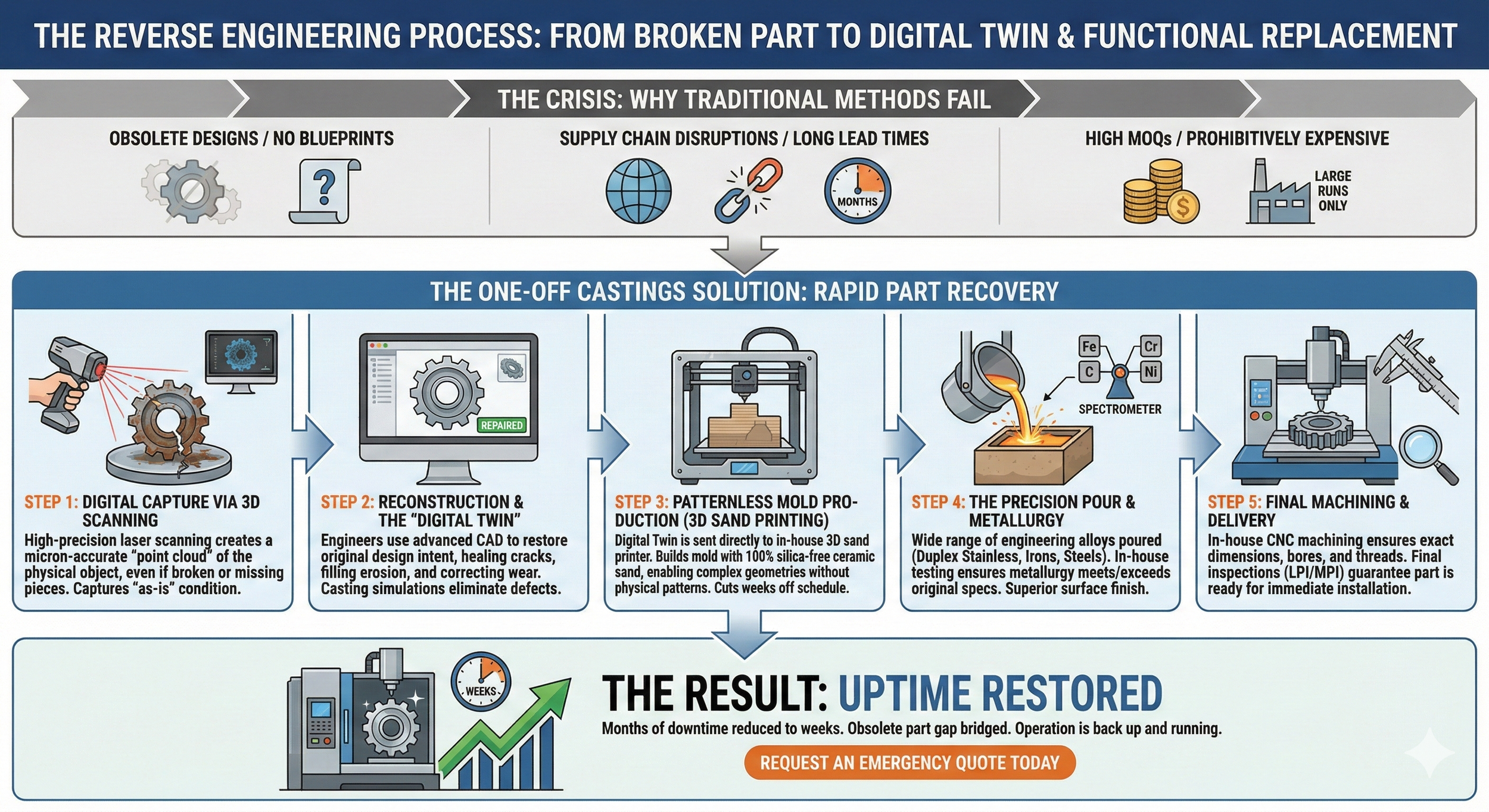
When a critical component fails in an industrial setting, the clock starts ticking. Downtime isn't just an inconvenience; it's a direct hit to the bottom line, costing thousands per hour. Often, the original manufacturer is out of business, the part is obsolete, or the lead time for a replacement is simply unacceptable. This is where One-Off Castings steps in, transforming a broken physical part into a precise digital twin, and then into a functional metal replacement, often faster than you thought possible.
Our Reverse Engineering Process is the cornerstone of our rapid part recovery service. It's a meticulous, multi-step approach that leverages cutting-edge technology and deep metallurgical expertise to recreate any component, regardless of its age or complexity, without the need for original blueprints or patterns.
The Crisis: Why Traditional Methods Fail
Before diving into the solution, it's crucial to understand the common pitfalls that lead to extended downtime:
- Obsolete Designs: Many critical machines in operation today were designed decades ago. Original patterns or CAD files may be lost, damaged, or simply never existed digitally.
- Supply Chain Disruptions: Even if a part is still manufactured, global supply chain issues can stretch lead times to months, leaving equipment idle.
- High Minimum Order Quantities (MOQs): Traditional foundries often require large production runs, making a single replacement part prohibitively expensive or impossible to source.
- Lack of Documentation: For many legacy components, the only existing "blueprint" is the physical part itself—often worn, corroded, or broken into multiple pieces.
Step 1: Digital Capture via 3D Scanning
The process begins with high-precision 3D laser scanning. Unlike traditional manual measurements which are prone to human error, our scanners capture millions of data points to create a "point cloud" of the physical object.
Even if your part is shattered or has missing sections, we can scan the remaining pieces. This digital foundation allows us to see the "as-is" condition of the component with micron-level accuracy.
Step 2: Reconstruction and the "Digital Twin"
Once we have the scan data, our engineers move into the digital reconstruction phase. We don't just copy the worn part; we restore it to its original design intent.
Using advanced CAD software, we "heal" cracks, fill in eroded sections, and correct for years of mechanical wear. The result is a perfect Digital Twin—a 3D model that represents the part exactly as it was meant to function when it first left the factory. At this stage, we can also perform casting simulations to ensure the metal will flow perfectly during the pour, eliminating defects before they happen.
Step 3: Patternless Mold Production (3D Sand Printing)
This is where One-Off Castings leaves traditional foundries behind. Instead of spending 8-12 weeks and thousands of dollars building a physical wood or metal pattern, we send the Digital Twin directly to our in-house 3D Sand Printer.
The printer builds the mold layer-by-layer using 100% silica-free ceramic sand. This technology allows us to create internal geometries and complex cores that are impossible with traditional tooling. Because there is no physical pattern to build or store, we cut weeks off the production schedule.
Step 4: The Precision Pour and Metallurgy
With the mold printed, we move to the pour. We aren't limited to basic irons; we pour a wide range of engineering alloys, including Duplex Stainless Steel, Gray Iron, Ductile Iron, and specialized Steels.
Our in-house spectrometers and tensile testing ensure the metallurgy of your new part meets or exceeds the original specifications. Because we use ceramic sand, the resulting surface finish is superior to traditional sand castings, reducing the need for extensive post-process machining.
Step 5: Final Machining and Delivery
The final step is bringing the casting to its finished dimensions. Our in-house CNC machining center ensures that every mounting surface, bore, and thread is exactly where it needs to be. We perform final inspections, including Liquid Penetrant (LPI) or Magnetic Particle Inspection (MPI) where required, to guarantee the part is ready for immediate installation.
The Result: Uptime Restored
What used to take months now takes weeks. By combining reverse engineering with patternless 3D sand printing, One-Off Castings provides a bridge over the "obsolete part gap." We don't just give you a part; we give you your operation back.
Is a critical machine down right now? Don't wait for a pattern that doesn't exist. Contact the One-Off Castings team today and let us turn your broken part into a digital twin.